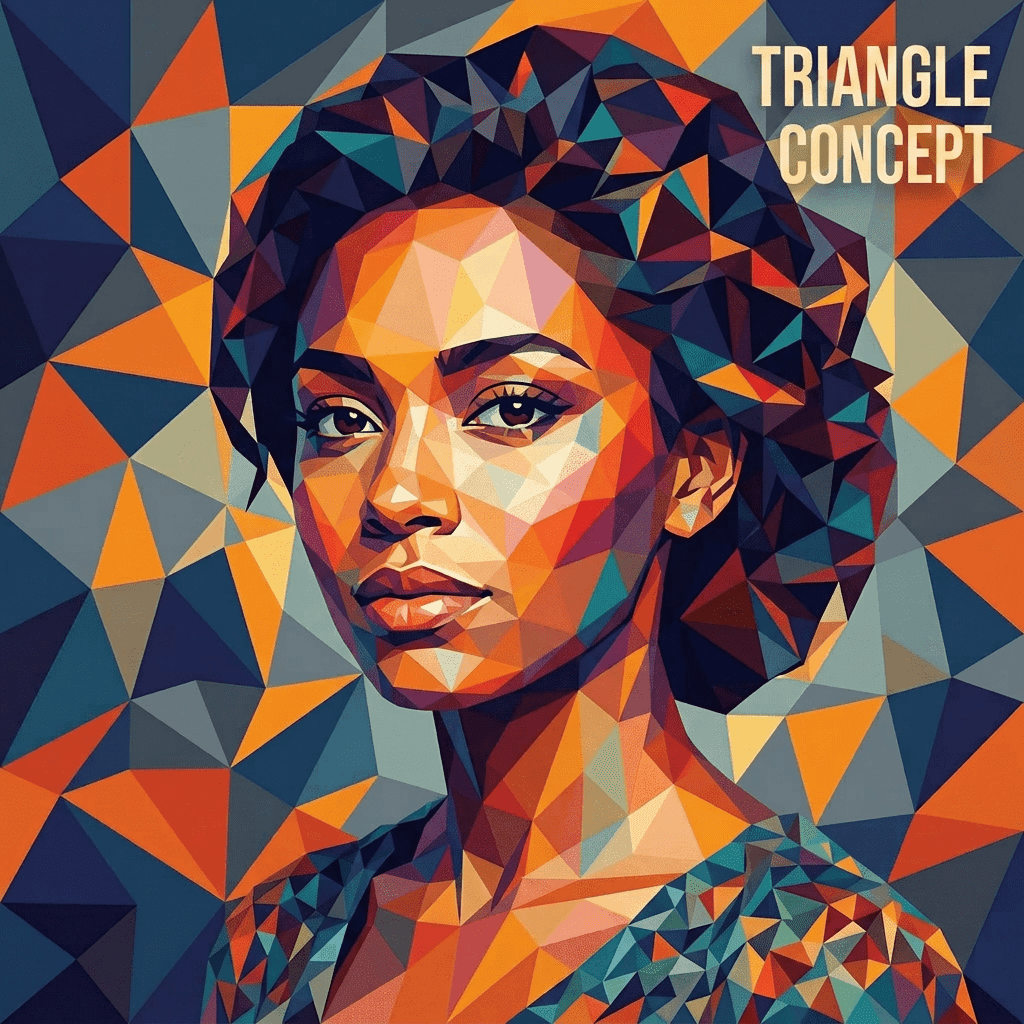
Geometric shapes art will completely shatter your perception of how a human face can be brought to life on canvas.
Maya’s eyes darted across the digital canvas, her heart hammering against her ribs like a trapped bird. Midnight was only five minutes away, the gallery curator was notoriously ruthless, and her entire career hung by a single, desperate thread. Her submission—a portrait of her late grandfather—was supposed to be a masterpiece, but it looked flat, lifeless, and utterly generic. Suddenly, a wild spark of panic-driven genius struck her; she seized her stylus, deleted every smooth brushstroke, and began slicing the digital face into hundreds of sharp, interlocking polygons. With only sixty seconds left on the clock, she stepped back, gasping as the chaotic web of sharp angles suddenly fused into a breathtaking, deeply emotional gaze that seemed to stare right through her soul. She hadn’t just saved her exhibition; she had unlocked the hypnotic, transcendent magic of low-poly portraiture.
Step inside this vibrant world where strict math meets raw human emotion, and let’s uncover how geometric shapes art turns rigid polygons into timeless masterpieces.
Why do simple triangles hold so much emotional power?
Triangles are the ultimate chameleons of the art world because they possess inherent structural tension. Unlike soft circles or static squares, every triangle points somewhere, creating a natural sense of motion, direction, and energy. When you use them to build a human face, you are engaging in a highly sophisticated style known as low-poly art.
By stripping away smooth curves and replacing them with sharp facets, you force the human brain to work a little harder to interpret the image. This cognitive puzzle actually makes the artwork more engaging! According to visual perception studies compiled by the Frontiers in Psychology Journal, our brains naturally seek patterns and symmetry, meaning viewers will spend more time interacting with a geometric portrait as their minds piece together the abstract fragments into a recognizable human form.
How do artists choose the perfect mathematical angles?
Creating a striking portrait entirely out of three-sided shapes isn’t random—it requires a brilliant understanding of light, shadow, and human anatomy. Artists use a technique called Delaunay Triangulation to map out the face. This method ensures that no point of any triangle lies within the circumcircle of another, creating a beautifully balanced grid that perfectly mimics how light hits a three-dimensional object.
To make a portrait look realistic, the triangles must vary dramatically in size. You use tiny, dense clusters of triangles around highly detailed areas like the pupils, the nostrils, and the corners of the lips to capture micro-expressions. Conversely, you use much larger, sweeping triangles across flat planes like the cheeks, forehead, and background to create depth and contrast. The result is a stunning digital mosaic that feels simultaneously ancient and futuristic.
What digital tools can unlock your inner geometric genius?
You don’t need a degree in advanced calculus to start creating your own masterpiece. The modern digital art revolution has made this intricate style incredibly accessible. Professional vector software like Adobe Illustrator is the gold standard, allowing you to use the Pen Tool to precisely snap anchor points together so there are no awkward gaps between your shapes.
If you want to speed up the process, there are incredible automated tools and generators available. For instance, open-source platforms and coding libraries featured on GitHub allow artists to upload a standard photograph and automatically convert it into a baseline triangle mesh using custom algorithms. From there, you can manually adjust the colors, shift the vertices, and inject your own personal artistic flair to make the portrait truly pop.
Can a portrait made of sharp edges actually look soft?
It sounds like a paradox, but the secret lies entirely in your color palette and shading. By blending subtle gradients across neighboring triangles, you can simulate the soft glow of skin, the silkiness of hair, or a gentle glint in the subject’s eye.
When you master the interplay between warm highlights and cool shadows, those sharp geometric boundaries begin to melt away from a distance. The viewer’s eye automatically blends the distinct blocks of color together—a modern digital evolution of the Impressionist pointillism technique. It is proof positive that rigid math doesn’t suffocate creativity; instead, it provides the perfect, unbreakable framework for profound artistic expression.

One response to “a portrait created entirely from triangles”
Gorgeous