
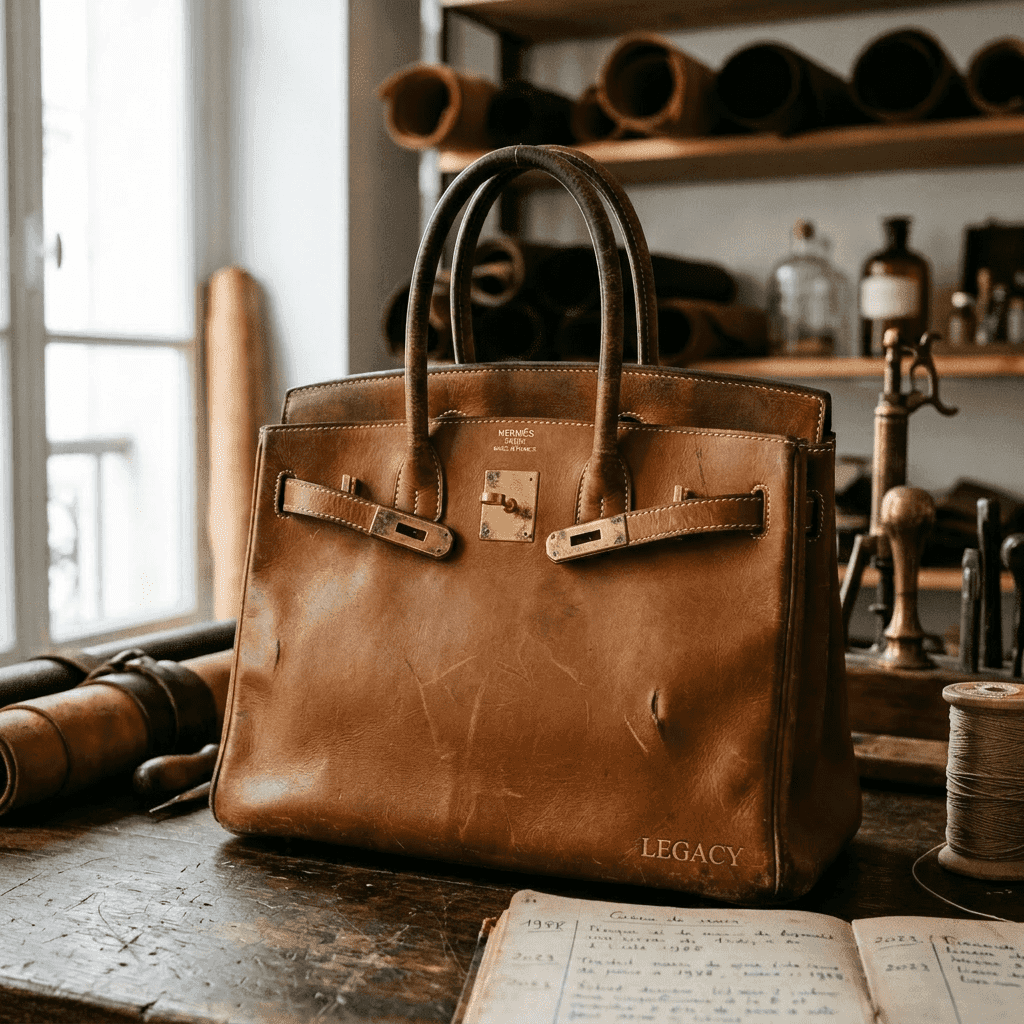
A single accessory rules the fashion world from a throne made of Togo leather and diamond-encrusted hardware. It is not just a purse; it is an economic phenomenon, a cultural icon, and the ultimate symbol of elite status. Today, we are deep-diving into The history and legacy of the Hermès Birkin—a masterpiece of design that outpaces the stock market and turns heads in every major fashion capital. Grab your champagne, darling, because this is going to be a thrilling, glamorous ride through the upper echelons of haute couture!
What is the Elitely Dramatic Story Behind the Sky-High Legend?
Picture this: The year is 1983. Turbulences shake an Air France flight cruising somewhere between Paris and London. In first class, a stunning, free-spirited British actress scrambles to push her trademark wicker basket bag into the overhead compartment.
Suddenly, disaster strikes! The basket slips.
With a dramatic gasp from the surrounding passengers, the bag’s entire contents—baby bottles, diapers, loose notebooks, and personal keys—tumble through the air, raining down frantically across the aisle.
“Mon dieu!” she cries out, exasperated. She flings herself into her seat next to a sophisticated, impeccably dressed gentleman. “Why is it impossible to find a luxury leather weekend bag that actually holds everything a modern woman needs?” she sighs dramatically, her eyes locked with his.
The gentleman smiles warmly, his eyes twinkling with an artistic fire. “You should have a bag with pockets,” he notes smoothly.
She rolls her eyes playfully. “The day Hermès makes a practical tote with pockets, I will buy it instantly!”
He bows his head slightly. “But, ma chérie… I am Hermès.”
The stranger was none other than Jean-Louis Dumas, the legendary Executive Chairman of the French luxury house. Right there, amidst the clouds, a fierce artistic passion ignited. Jane Birkin grabbed an airplane sickness bag, unsheathed a pen, and together they furiously sketched a revolutionary hybrid—larger than a Kelly bag, smaller than a suitcase, equipped with deep, secure pockets and a fiercely elegant silhouette.
By the time the plane touched down on the tarmac, fashion history had been rewritten forever. The ultimate “It-Bag” wasn’t born in a sterile corporate office; it was forged in a moment of sheer high-altitude drama!
How Did a Simple Flight Sketch Become a Global Empire?
When the official design made its grand debut in 1984, the world met the very first Hermès Birkin Bag. It was an absolute revelation of pure, unadulterated functionality and elite aesthetics.
The bag was structured with a rectangular shape, a dedicated burnished flap, dual rolled handles, and a signature turn-lock closure secured by a padlock and keys. Unlike its predecessor, the Grace Kelly-inspired bag, the Birkin was engineered to stay open smoothly, allowing glamorous women to effortlessly reach inside while on the move.
Every single piece was—and still is—painstakingly sewn by a single artisan using the house’s legendary, unbreakable 19th-century saddle-stitch method. To prove its timeless historical worth, Jane Birkin’s actual, original prototype bag was auctioned off in Paris at Sotheby’s Auction House, fetching a mind-blowing, historic price of over $10 million from an elite collector!
Why is the Legacy of the Birkin Considered Better Than Gold?
The true brilliance of the history and legacy of the Hermès Birkin lies in its astonishing financial power. It is widely recognized by economic experts as a premier “Veblen good”—a product where high demand directly correlates with its sky-high pricing and extreme scarcity.
You cannot simply walk into an Hermès boutique and buy one off the shelf. Instead, you must build an elite relationship with a sales associate, spend thousands on silk scarves and homeware, and hope to be “offered” the privilege of purchasing a Birkin. This intense layer of exclusivity has created an absolute frenzy on the secondary market.
While a retail piece may cost anywhere from $10,000 to over $30,000, elite variations like the ultra-rare Himalaya Birkin—crafted from Niloticus crocodile skin and encrusted with white gold and diamonds—regularly command upwards of $350,000 to $500,000 at elite auctions. Studies show that the Birkin’s annual return on investment regularly outperforms both gold and the S&P 500 index, proving that style can be the smartest financial move you ever make!
Which Sizes and Exotic Leathers Rule the Luxury Market Today?
The modern evolution of the bag offers jaw-dropping variety tailored to the elite jet-set lifestyle. The iconic sizes are named directly after their base width in centimeters:

The compact, modern darling perfect for day-to-night essentials.

The ultimate everyday companion balancing style and space.

The classic size originally favored by Jane Birkin herself.

The ultimate travel weekender bag that commands respect.
When it comes to materials, collectors split into two passionate camps: durable calfskins like Togo, Clemence, and Epsom leather, or the jaw-dropping exotic lineup consisting of polished alligator, lizard, and sleek ostrich skin. It is an ever-evolving playground of colorways and textures that ensures the legacy will never go out of style.
