
Why Did Ancient Masters Obsess Over Absolute Perfection?
Forget everything you think you know about old, dusty museum relics. Classical Greek art isn’t just a collection of cold, white marble statues staring blankly into space. It was the ultimate, high-octane visual revolution of the ancient world! Running from roughly 480 BC to 323 BC, this explosive era was fueled by an intense, borderline-obsessive desire to capture the absolute peak of human physical perfection. The ancient Greeks looked at the human body and thought, “We can make this divine.” They stopped carving the stiff, rigid, blocky figures of the older Archaic period and unlocked the secret to true, fluid movement. They didn’t just want to copy life; they wanted to upgrade it. Through meticulous mathematical balance and a deep study of anatomy, they created a visual language of idealized beauty that still dictates our modern world’s ideas of symmetry and aesthetics. If you have ever stared at a masterpiece and felt a sudden rush of awe, you have experienced the calculated magic of classical craftsmanship.
What Was the Forbidden Scandal Behind the Spear Bearer?
Let us drop you right into the heart of ancient Polykleitos’ workshop in 440 BC. Picture the intense scent of hot bronze, the rhythmic clink-clink of iron chisels, and a master sculptor ripping his hair out in sheer frustration. He was trying to solve a massive problem: how do you make a heavy, solid bronze man look like he is casually walking through the air?
The result of his obsession was the Doryphoros, famously known as the Spear Bearer. Polykleitos didn’t just sculpt a random athletic guy; he wrote an entire mathematical treatise called The Canon, using strict geometric ratios to dictate the ideal human form.
To make it look alive, he pioneered a radical stance called contrapposto. He placed all the weight on one single, locked leg, causing the hips to tilt, the torso to shift, and the opposite arm to relax. This brilliant, asymmetrical counter-balance creates an illusion of lifelike motion. The crowd at the unveiling didn’t just clap—they gasped. Rumors swirled that Polykleitos had used forbidden mathematical sorcery to steal the proportions of the gods themselves. It was an artistic triumph so powerful that it completely redefined sculptural anatomy forever.
Did You Know the Statues Were Actually Technicolor?
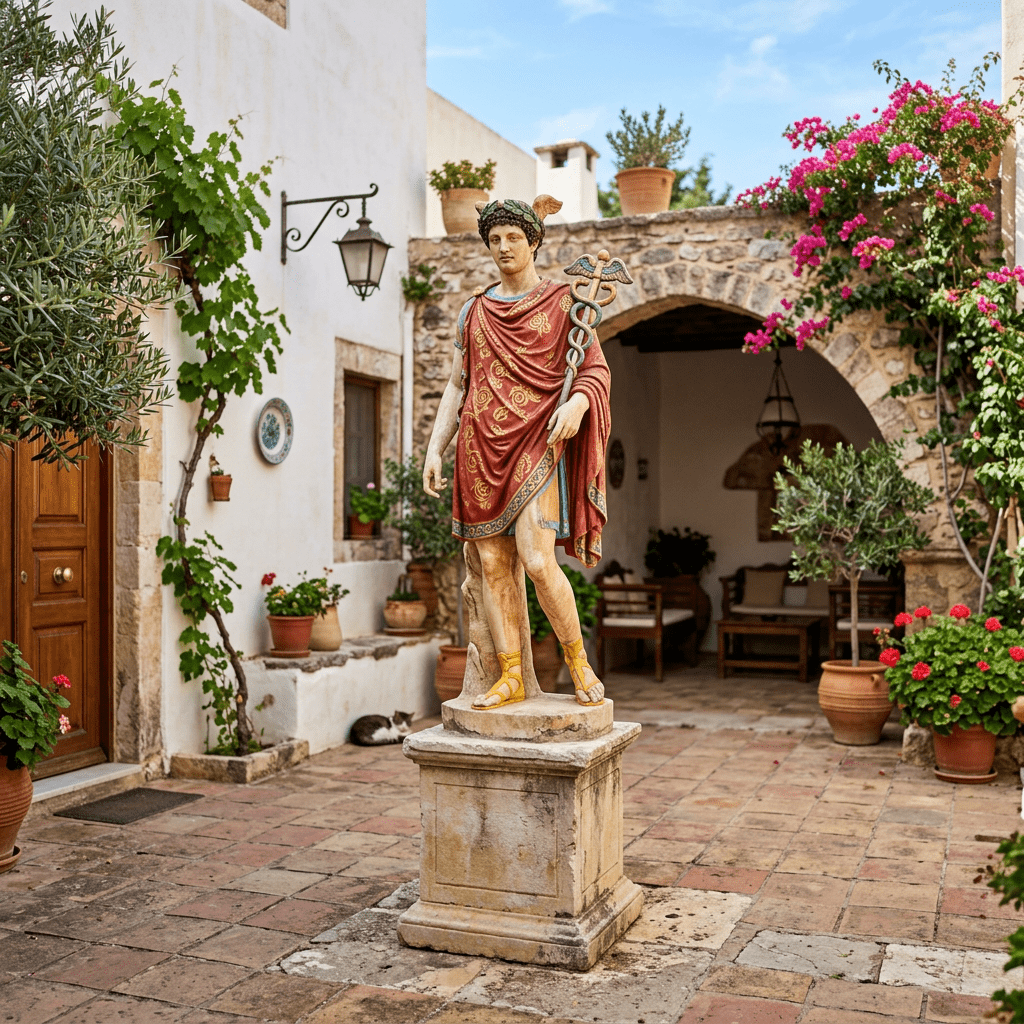
Prepare to have your mind completely blown: the pristine, blindingly white marble aesthetic we associate with the ancient world is a total historic lie! When these statues stood proud in the temples of Athens, they weren’t white. They were wrapped in a blazing, neon, technicolor explosion.
Classical artists coated their masterpieces in rich, vivid pigments derived from ground minerals, precious stones, and animal products. They used bright Egyptian blue, deep cinnabar red, and shimmering gold leaf. To make the figures look terrifyingly real, sculptors went as far as adding:
- Painted stone eyelashes
- Intricate, glowing glass eyes
- Polished silver teeth
- Real bronze weapons tucked into marble hands
Over thousands of years, the harsh Mediterranean sun, corrosive soil, and aggressive cleanings by early museums completely scrubbed away these pigments. What we see today is just the naked skeleton of what was once a roaring, multi-colored spectacle!
How Did the Parthenon Architects Cheat Your Eyes?
If you stand directly in front of the Parthenon in Athens, you will swear that every single column is perfectly straight, every step is perfectly flat, and the entire structure is a masterclass in right angles. The truth? It is a brilliant architectural illusion. The master architects Iktinos and Kallikrates knew a fundamental truth about human anatomy: the human eye is inherently flawed and easily tricked.
If you build a massive building with perfectly straight lines, optical illusions make the middle sag and the columns look thin and warped. To fix this, they engineered a series of mind-bending optical corrections called entasis:
- Every horizontal step curves slightly upward toward the center.
- The massive temple columns swell outward in the middle.
- Every single pillar leans slightly inward toward the building’s core.
If you extended those columns miles into the sky, they would eventually meet to form a perfect pyramid! The Parthenon was deliberately built crooked just so it would look perfectly straight to a human observer standing on the ground.
Why Does This Ancient Visual Revolution Still Matter Today?
Why are we still obsessing over pieces of broken stone sculpted over two millennia ago? Because the DNA of Classical Greek art is woven directly into the fabric of our modern visual culture. When the Roman Empire conquered Greece, they didn’t destroy the art—they copied it, distributed it, and built their entire civilization on its aesthetic foundations.
During the Renaissance, masters like Michelangelo dug up these long-buried Greek ruins and used them to fuel their own creative explosions. Every time you see a superhero on a movie poster striking a dynamic, weight-shifting pose, you are looking directly at Polykleitos’ contrapposto. Every grand government building with majestic, towering pillars is a direct nod to the architectural innovations of ancient Athens. The Greeks didn’t just make art; they cracked the universal code of human visual attraction, leaving behind a timeless blueprint that continues to shape how we view beauty, power, and perfection today.
