
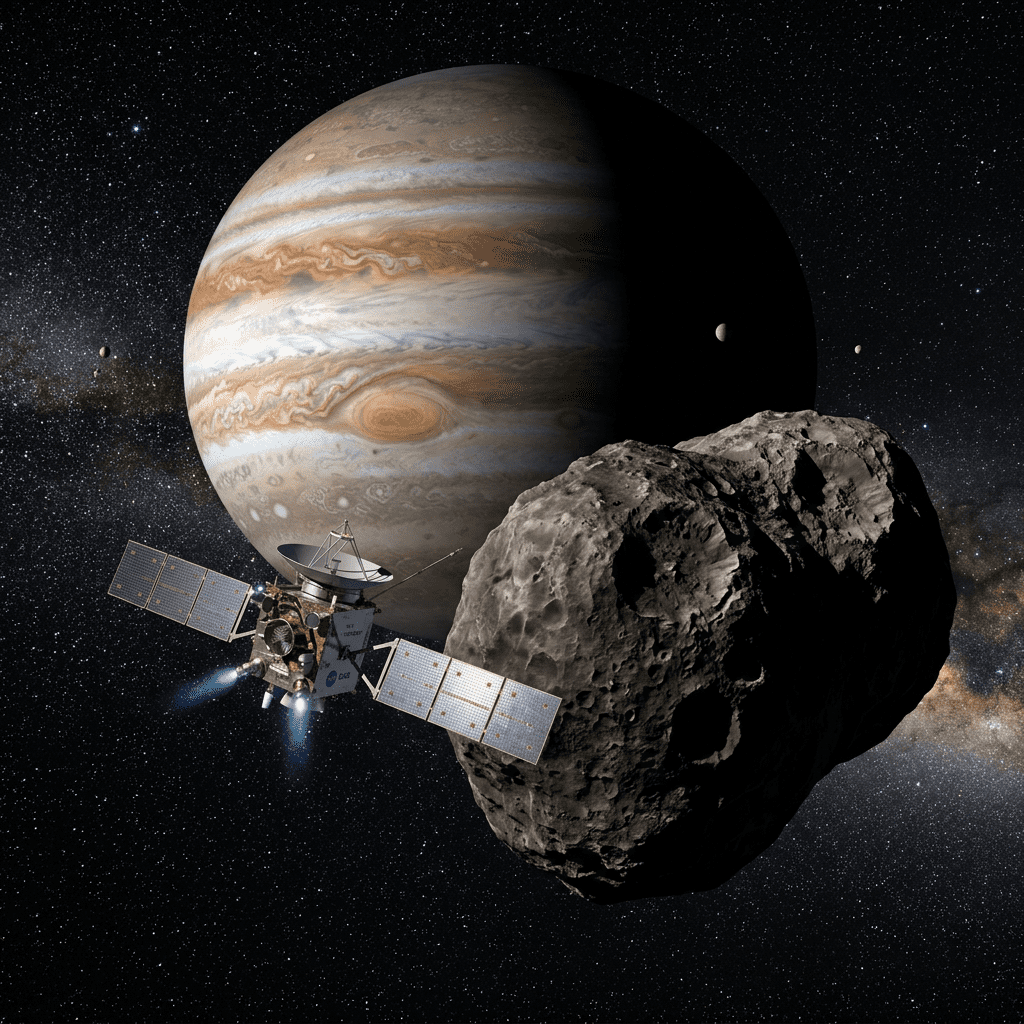
Humanity has gotten pretty good at mapping the solar system, but we are about to enter a high-octane era of deep-space discovery that will rewrite astronomy textbooks forever. Hurtling through the dark void right now is NASA’s Lucy spacecraft. It isn’t headed for another boring, well-mapped planet. Instead, Lucy is executing a wild, record-breaking 12-year grand tour to intercept the Jupiter Trojans—two massive, completely unexplored swarms of ancient asteroids that lead and trail Jupiter in its orbit around the Sun.
Forget about quiet, passive space observation. The upcoming 2027 flyby campaign is a high-energy, fast-paced cosmic heist. These pristine space rocks have been trapped in a gravitational tug-of-war between Jupiter and the Sun since the dawn of our solar system 4.5 billion years ago. They are the literal “fossils” of planet formation, and Lucy is about to bust their secrets wide open. Here is your detailed, high-utility blueprint to the upcoming 2027 Jovian Trojan encounters, featuring a dramatic engineering story that proves why this mission is a masterpiece of human grit.
How Did a Stubborn Solar Panel Spark a Heart-Stopping Drama in Deep Space?
To truly understand the insane stakes of this mission, we have to travel back to the moments immediately following Lucy’s flawless launch from Cape Canaveral. Imagine engineers at the mission control center celebrating as the spacecraft separated from its rocket and prepared to deploy its secret weapon: two massive, circular solar arrays designed to fan out like giant Chinese umbrellas to power the craft in the dim light of Jupiter.
Suddenly, telemetry data flashed a terrifying warning. While one solar array locked perfectly into place, the second mammoth panel jammed. Instead of latching completely, a loose lanyard left the critical array only 345 degrees open, unlatched, and vulnerable to snapping under the raw force of future engine burns. Lucy was barreling toward deep space with a crippled power supply and a structurally compromised frame.
The engineering team went into an absolute, high-stakes panic! Consequently, over the next several months, rogue teams of flight controllers and structural analysts pushed the spacecraft’s hardware to its absolute limits. Instead of giving up, they executed a daring, multi-stage recovery plan, firing both the primary and backup motor windings simultaneously to pull the lanyard with double force.
The tension in the room was a chaotic whirlwind of nervous breath and clicking keyboards! Ultimately, the brute-force maneuver succeeded, tensioning the array to a secure 357 degrees and stabilizing the craft for its journey into deep space. This dramatic engineering rescue proved that the team behind Lucy has the unstoppable main-character energy required to pull off the most complex orbital trajectory ever attempted.
What Massive Cosmic Treasures Will Lucy Intercept in 2027?
Moving forward from that heart-stopping rescue, the stage is officially set for the main event. Because the leading “Greek camp” of Trojans at the L4 Lagrange point is packed with a diverse mix of ancient matter, Lucy’s 2027 flyby schedule is a rapid-fire parade of spectacular alien worlds.
1. Eurybates (The Heavy-Hitting Gatekeeper)
- The Arrival: On August 12, 2027, Lucy makes its historic first entry into the Trojan swarm, screaming past the massive asteroid Eurybates.
- The Utility: Eurybates is a giant C-type (carbon-rich) asteroid that represents the largest remnant of a massive, ancient catastrophic space collision. Even more thrilling, Lucy will get a front-row view of its tiny, freshly discovered companion moon, Queta, giving scientists a two-for-one look at cosmic forensics.
2. Polymele (The Compact Powerhouse)
- The Speed-Run: Barely a month later, on September 15, 2027, Lucy zips past Polymele, the smallest of the primary Trojan targets.
The Utility: Measuring just 21 kilometers across, this ultra-dense, jagged rock is an absolute mystery. Ground-based tracking recently revealed that Polymele hides its own unnamed companion satellite, turning this quick flyby into an absolute goldmine of dynamic gravity data.
How Will the Remainder of the Greek Camp Unravel in 2028?
In addition to the explosive 2027 encounters, Lucy’s momentum will carry it deeper into the L4 swarm through 2028. Furthermore, the targets shift from carbon-rich remnants to mysterious, reddish D-type objects that likely originated in the icy outer fringes of the primordial Kuiper Belt.
- Leucus (The Slow-Motion Wobbler): On April 18, 2028, Lucy meets Leucus, a bizarre, elongated D-type asteroid with a painfully slow rotation rate. It takes a staggering 440 hours for Leucus to complete a single day-night cycle, meaning Lucy’s high-resolution L’LORRI camera will capture a unique, frozen-in-time surface landscape.
- Orus (The Crimson Enigma): Closing out the leading swarm on November 11, 2028, the spacecraft intercepts Orus. This highly reflective, organic-rich space rock is packed with volatile dark compounds. Studying Orus provides a direct look at the pristine, untouched materials that built giant gas worlds like Jupiter and Saturn.
Why Is the 2033 Patroclus Binary Flyby the Ultimate Grand Finale?
Ultimately, mixing an insane orbital path with sheer gravitational luck allows Lucy to pull off a maneuver no other spacecraft can match. After clearing the L4 camp in late 2028, Lucy will dive back toward Earth for a massive gravity assist, slingshotting itself completely across the solar system to the L5 “Trojan camp” trailing behind Jupiter.
- The Twin Titans: On March 2, 2033, Lucy arrives at its final, most challenging destination: the spectacular binary system of Patroclus and its near-equal-mass partner, Menoetius.
The High-Inclination Flex: These giant, 100-kilometer-wide P-type titans travel on a heavily tilted orbit far above the flat plane of the solar system, making them normally completely impossible to reach. By catching them exactly as they pass through the ecliptic plane, Lucy will execute a historic double-flyby of a primordial binary pair that has stuck together since the dawn of time.
Final Thoughts: The Journey to Our Origins Has Begun
In short, the Lucy mission isn’t just a basic scouting trip; it is an epic, high-stakes archeological dig into the deepest basement of our cosmic history. So, pull up a seat and get ready for the spectacular data drops, because the 2027 flybys are going to pull back the curtain on the chaotic, violent birth of our solar system. Keep your eyes locked on the stars—human curiosity is officially claiming the cosmic frontier!
