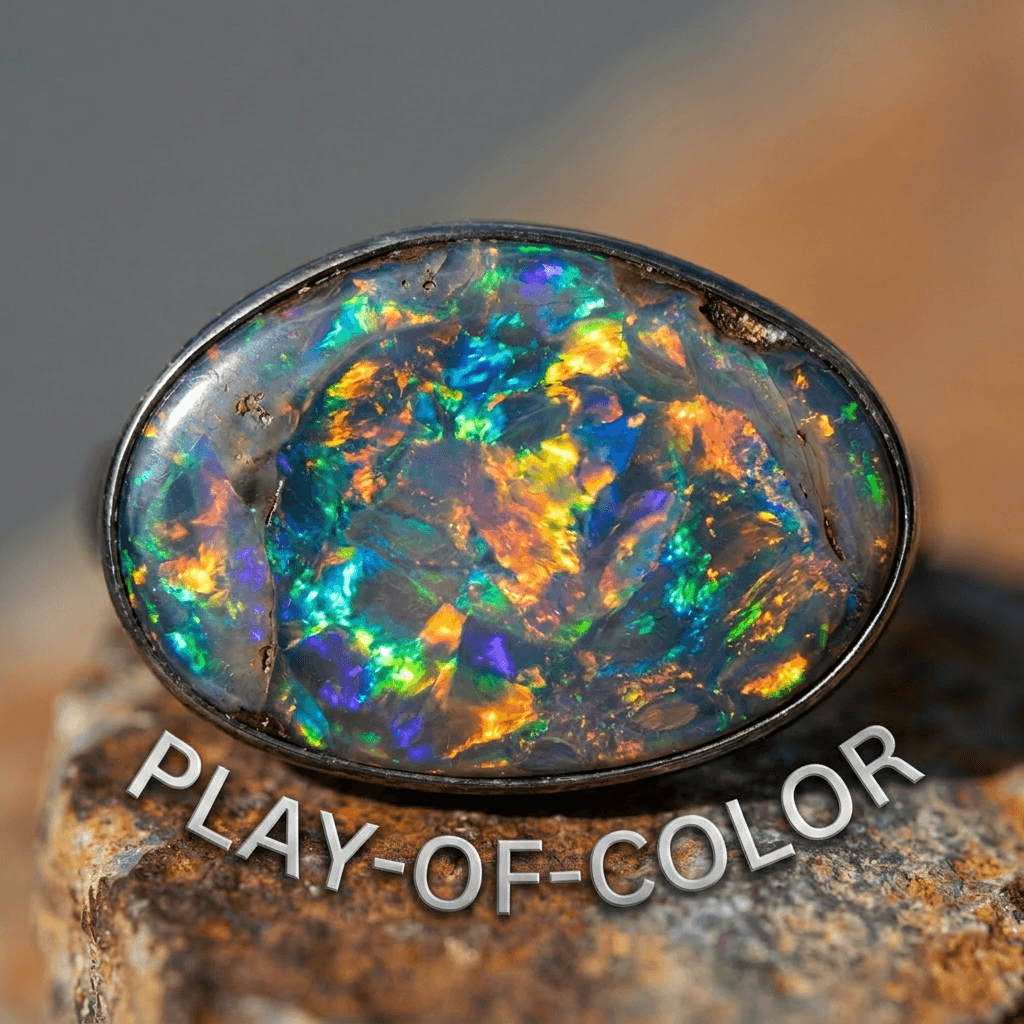
Prepare to have your mind completely blown by a stone that holds an absolute, living rainbow captive within its frozen depths! If you have ever stared into the fiery abyss of a high-end gemstone and wondered how earth, water, and light could collide to create a shifting kaleidoscope of pure, neon energy, you are searching for the secrets of the cosmos. The secret to this spellbinding visual orchestra is none other than the Play-of-Color: The diffraction magic inside precious Opals. This isn’t just a basic optical trick; it is a microscopic symphony where ordinary physics morphs into an absolute masterpiece of natural engineering.
Want to hear the legend of the lightning stone?
Long before modern mineralogy could dissect the stone, ancient cultures looked at the gemstone and saw something entirely supernatural. The ancient Arabs spun a highly dramatic tale, firmly believing that opals fell straight from the heavens during violent thunderstorms. They swore that the blinding, electric flash of a real lightning bolt was permanently trapped forever inside the rock, explaining its fiercely shimmering, unpredictable display of colors. Imagine an ancient nomad holding a dark, raw stone under a desert moon, suddenly witnessing a burst of neon violet and crimson fire erupt from within. It felt alive, reactive, and dangerous—a piece of the sky stolen by the earth, holding a crackling storm hostage in a silent cage of solid silica.
How does the structural grid orchestrate this neon rave?
The real science behind the gemstone is even more thrilling than the myths! Unlike traditional gems like rubies or sapphires that get their rich hues from chemical impurities like chromium or iron, opal has zero pigment. According to the University of Waterloo Earth Sciences Museum, the hypnotic effect is caused by a unique structural grid. Precious opal is a hydrated amorphous mineraloid composed of millions of sub-microscopic silica spheres stacked in a flawlessly organized, three-dimensional close-packed lattice. When white light strikes this hyper-ordered grid, it bounces into the minute, water-filled voids between the spheres. Instead of passing straight through, the light waves are forced to bend, split, and physically break apart. This beautiful process is called Bragg diffraction, and it behaves exactly like a natural, microscopic prism slicing pure white light into its hidden, neon components.
Why do some opals flash red while others stay blue?
It all comes down to an ultra-precise cosmic tape measure. The specific colors that leap out at your eyes are strictly determined by the exact diameter of the stacked silica spheres and the gaps between them.
- Small spheres: Nano-spheres measuring roughly 150 nanometers create highly constricted gaps, allowing only the shortest wavelengths of light—like vibrant violet and deep electric blue—to diffract out.
- Large spheres: Larger spheres reaching up to 350 nanometers create much larger internal channels. These grand structural pathways allow the longest wavelengths, such as fiery orange and brilliant crimson red, to burst forward.
Because growing large, perfectly uniform spheres over millions of years requires immaculate environmental stability, red-flashing precious opals are the rarest and most expensive stones on the planet. If the spheres settle randomly without order, you get “common opal,” which has a milky luster but absolutely zero color play.
Can humans replicate this magnificent natural phenomenon?
Because the mesmerizing Play-of-Color: The diffraction magic inside precious Opals relies entirely on physics rather than chemistry, faking it convincingly is an absolute nightmare for counterfeiters. You can’t just dye a boring rock and call it a day! To create synthetic stones, scientists had to master growing perfectly uniform nano-spheres in a laboratory environment, resulting in what are known as Gilson Opals. However, nature always leaves a signature signature. If you inspect a synthetic opal under a jeweler’s loupe, you will notice the artificial spheres stack in columns that are far too perfect. This creates an unnatural, geometric pattern that looks exactly like a chain-link fence or scaly lizard skin. True, natural precious opals display their shifting colors in beautifully organic, chaotic, and irregular patches that can never be truly duplicated by human hands.
