
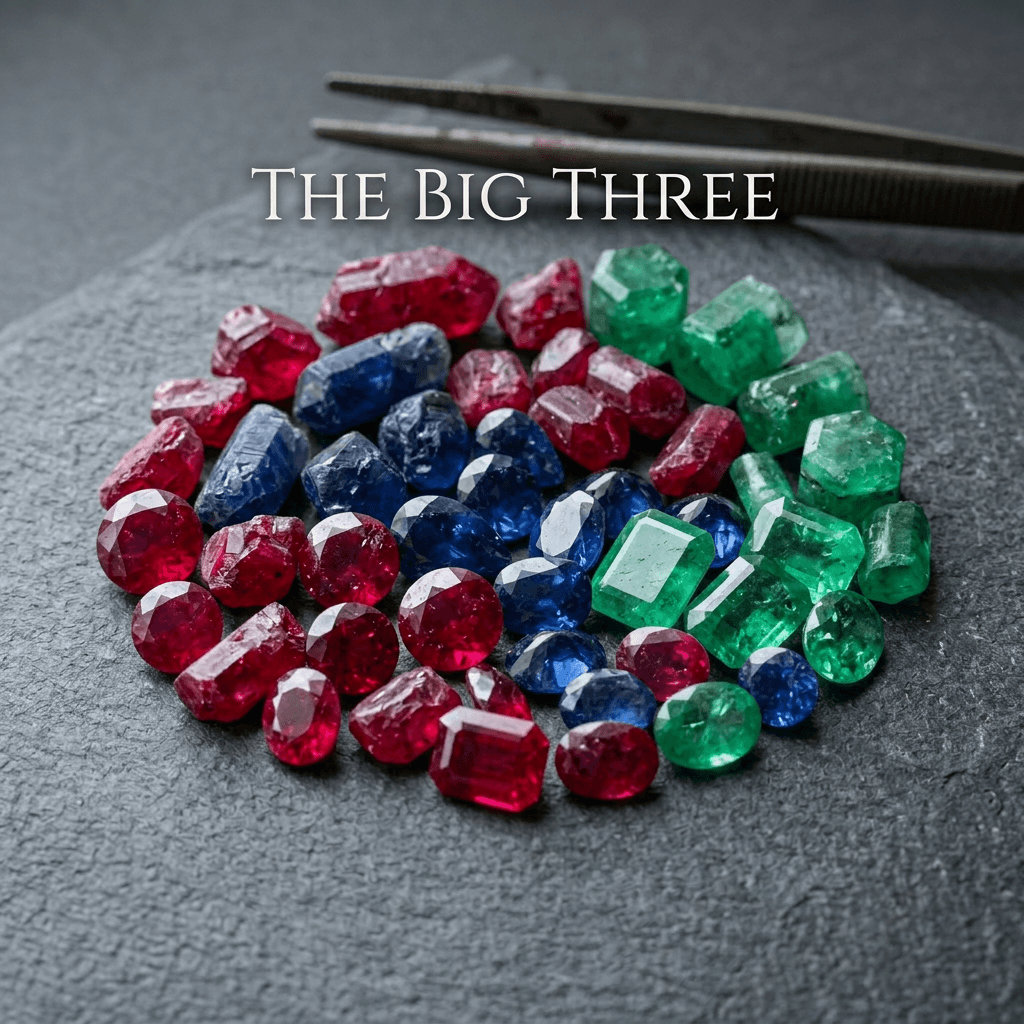
The Big Three: Ruby, Sapphire, and Emerald is your golden ticket into a dazzling world of high-stakes glamour, intense geological drama, and undeniable luxury.
Ready for an Elite Tale of Betrayal, Passion, and Jewels?
The ballroom at the Monaco auction was suffocatingly hot, but Evelyn’s veins ran completely ice-cold. She stared at the velvet case on the podium containing the “Siren’s Blood”—a legendary 15-carat Burmese ruby radiating a deep, terrifyingly perfect pigeon’s blood red. Beside her, Julian smirked, his fingers casually twirling a flawless, velvet-blue Kashmir sapphire cufflink that perfectly matched his calculated, deceptive eyes.
“You don’t have the capital to outbid me, Evelyn,” Julian whispered, his voice a smooth purr of pure malice. “The Big Three always belong to those who can master them.” Evelyn smiled, a sharp flash of white teeth against the dim lighting. She adjusted the spectacular, glowing green Colombian emerald gracing her neckline, its natural “jardin” inclusions shimmering like a secret forest trapped in crystal. As the auctioneer slammed the gavel down on Julian’s staggering twenty-million-dollar bid, Evelyn stepped forward into the spotlight. She didn’t offer money; instead, she revealed a verified laboratory report from the Gemological Institute of America (GIA) proving Julian’s prized sapphire had been heavily beryllium-diffused in a furnace, while her own assets remained entirely pristine and unheated. Julian’s face drained of color as the elite crowd gasped; the king of the auction house had been dethroned by a woman who truly understood the science of wealth.
Why Are They Known as the Big Three?
The colored gemstone market revolves around an elite trifecta often referred to by experts at National Jeweler as the Big Three. While diamonds grab the mainstream headlines, ruby, sapphire, and emerald command the true respect of historical royalty and elite collectors alike. They represent the peak of rarity, market value, and rich cultural symbolism among all colored stones. In fact, fine specimens from this trio can frequently fetch higher prices per carat at auction houses than colorless diamonds
What Secrets Lie Within the Fiery Ruby?
- Mineral Species: Rubies are the ultra-rare, red variety of the mineral corundum.
- The Crimson Chromophore: Trace amounts of chromium invading the crystal structure create its brilliant red hue.
- Unmatched Hardness: Scoring a phenomenal 9 on the Mohs hardness scale, it is second only to diamonds.
- The Ultimate Tint: The most coveted and expensive shade in the trade is a vibrant, saturated crimson known as “pigeon’s blood” red.
- Ancient Majesty: In ancient Sanskrit, the ruby was crowned ratnaraj, which translates directly to the “King of Precious Stones”.
What Makes the Sapphire So Enchanting?
- The Corundum Sibling: Sapphires share the exact same mineral family as rubies, representing all non-red corundum colors.
- The Blue Chemistry: Classic blue sapphires owe their gorgeous, deep ocean colors to trace mixtures of iron and titanium.
- Fancy Variations: They can form in spectacular “fancy” colors including pink, orange, yellow, purple, and green.
- The Royal Blue: Highly prized, historical specimens from Kashmir display an iconic, velvety cornflower blue texture.
- The Padparadscha Rarity: An exceptionally rare pinkish-orange variety named after the delicate lotus blossom.
Why Is the Emerald Considered Geologically Impossible?
- The Beryl Matrix: Emeralds belong to the beryl mineral species, which is completely colorless in its purest form.
- The Green Miracle: Beryllium must miraculously bond with chromium or vanadium deep in the earth to spark that vivid green.
- The Internal Garden: Unlike other gems, emeralds are celebrated for their internal fractures and inclusions, beautifully called jardin.
- Delicate Architecture: Scoring 7.5 to 8 on the Mohs scale, they are more brittle than corundum and require expert cutting.
- Visual Illusion: Because beryl has a lower density than diamonds, a one-carat emerald looks visually larger than a one-carat diamond.
How Can You Verify Real Value from Imitations?
Navigating the high-end gemstone market requires an ironclad strategy to avoid treated or synthetic counterfeits. Always demand a certified report from a top-tier independent laboratory like the GIA Colored Stone Research team or the Swiss GRS. These institutions utilize highly advanced Laser Ablation Mass Spectrometry to detect artificial heat treatments, glass-flux fillings, or polymer resins. Embracing the breathtaking history and complex science of The Big Three: Ruby, Sapphire, and Emerald ensures you invest in timeless treasures that will retain their mesmerizing power for generations to come.
