
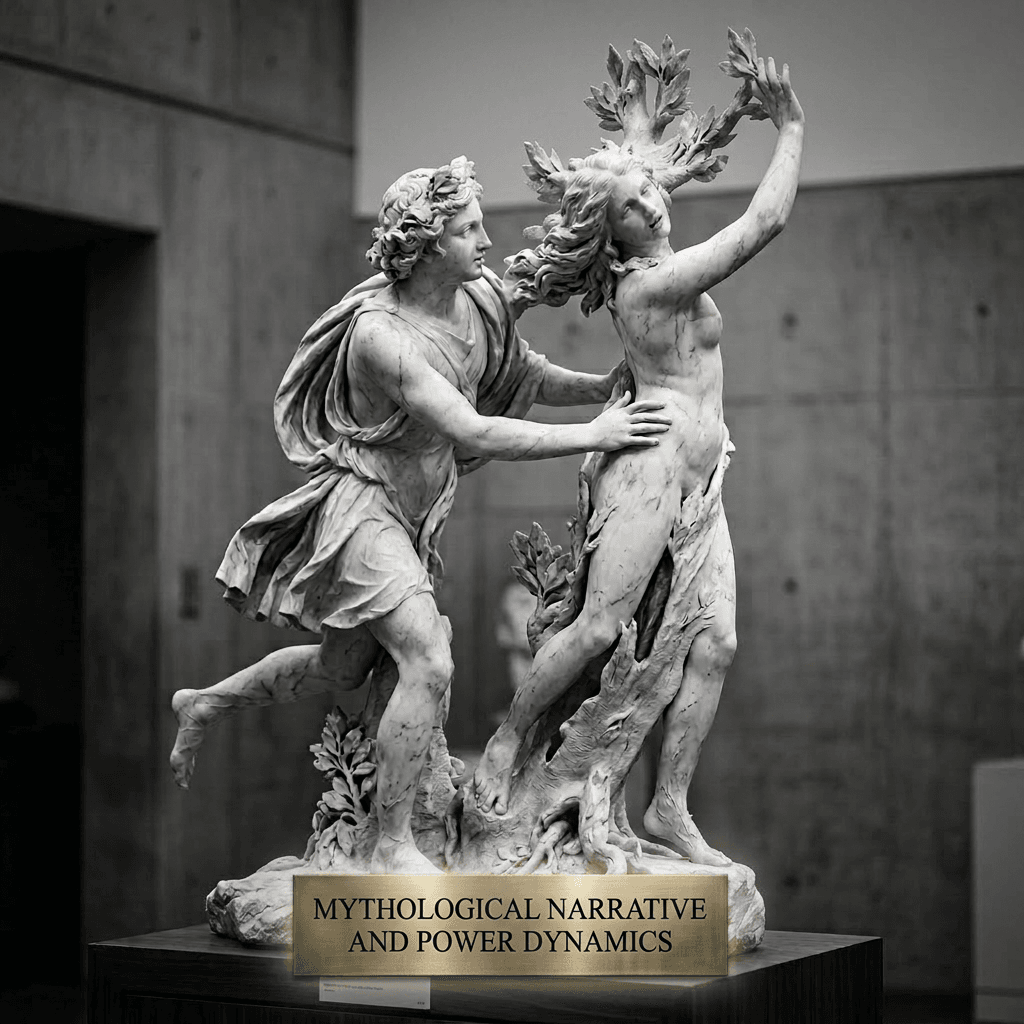
Mythological Sacrifice and Power Dynamics dictate how we view the historical tightrope walked between ultimate devotion and individual freedom. Imagine sprinting through a dense, ancient forest, the ground scraping your bare feet, while the literal God of Music and Light breathes down your neck. This isn’t a bad dream; it is the high-stakes reality of the nymph Daphne fleeing the love-struck Apollo. When we examine the classic Apollo and Daphne myth, often rendered in sculpture, it raises thought-provoking questions about consent, devotion, and the pursuit of freedom. It forces us to confront an uncomfortable truth: historically, a woman’s ultimate path to self-ownership required absolute, physical sacrifice.
Why Does Gian Lorenzo Bernini’s Sculpture Terrify and Amaze Us?
To truly understand how Mythological Sacrifice and Power Dynamics manifest in physical art, one must look at the legendary Galleria Borghese in Rome. Here stands Gian Lorenzo Bernini’s masterpiece, Apollo and Daphne, carved between 1622 and 1625.
The thriller-like intensity of this marble sculpture is unmatched:
- The Chase: Apollo’s hand strikes Daphne’s hip, his lips parted in desperate triumph.
- The Metamorphosis: Daphne’s fingers sprout delicate laurel leaves, her toes rooting deep into the earth.
- The Expression: Her mouth opens in a silent, petrified shriek as bark encases her torso.
- The Illusion: Heavy marble transforms into floating hair and translucent leaves right before your eyes.
Bernini captures the exact millisecond where autonomous life ends and botanical imprisonment begins. The sculpture visualizes the ultimate clash of power: a god demanding submission, and a mortal choosing to erase her humanity just to retain her sovereignty.
How Did Cupids Golden Arrow Trigger a Divine Thriller?
The backdrop to this chase is a masterclass in cosmic suspense and fragile egos. Fresh off slaying the monstrous Python, Apollo mocked Cupid’s archery skills, sneering that little boys shouldn’t play with warrior weapons. Never provoke a god with a quiver full of emotional collateral.
The vindictive sequence unfolded with brutal efficiency:
- The Gold Strike: Cupid shot Apollo with a golden arrow, igniting an obsessive, uncontrollable love.
- The Lead Strike: Cupid pierced the river nymph Daphne with a lead arrow, instilling an immediate, absolute hatred for romance.
- The Stalking: Apollo tracked Daphne through the wilderness, his predatory devotion intensifying with every step.
- The Ultimatum: Exhausted and trapped at the edge of her father’s river, Daphne realized flight was no longer an option.
This was not a romantic courtship; it was a divine thriller where the hunter possessed infinite immortality, and the hunted possessed only her will to remain unbound.
What Can Ovid’s Poetry Teach Us About Consent and Freedom?
Long before Bernini chipped away at marble, the Roman poet Ovid recorded this agonizing pursuit in his narrative poem, Metamorphoses. The text serves as the literary foundation for analyzing Mythological Sacrifice and Power Dynamics in classical literature.
Ovid’s verses lay bare the uneven terrain of ancient consent:
- Daphne’s Vow: Daphne explicitly begged her father, the river god Peneus, to let her remain a perpetual virgin, mirroring the fierce independence of the goddess Diana.
- Apollo’s Delusion: As Apollo chased her, he yelled out that he wasn’t an enemy, attempting to rationalize his pursuit by claiming his divine status made his love a privilege.
- The Devastating Choice: Daphne cried out to the river, “Destroy the beauty that injures me!”
By changing Daphne into a laurel tree, her father granted her plea for freedom, but at a catastrophic cost. Her independence required the complete sacrifice of her human form, highlighting how ancient narratives frequently equated a woman’s safety with her literal erasure.
How Does This Ancient Struggle Mirror Modern Power Dynamics?
The dynamic between Apollo and Daphne is not a relic confined to dusty museums; it serves as a foundational blueprint for analyzing modern institutional and interpersonal relationships.
The structural themes of this myth resonate across centuries:
- The Cost of Autonomy: Daphne had to give up her voice, her movement, and her humanity to preserve her boundaries.
- The Illusion of Devotion: Apollo’s “love” was entirely consumption-based, proving that obsession devoid of consent is merely a display of dominance.
- The Symbol of Victory: Even after her transformation, Apollo claimed the laurel tree as his sacred symbol, showing how top-tier powers appropriate the relics of those they conquer.
When analyzing the text through the digital collections of the Metropolitan Museum of Art, scholars consistently point out that the laurel wreath became a symbol of triumph and honor. Ironically, this universal badge of victory was born from a woman’s desperate act of self-defense.
Ultimately, the myth challenges us to rethink how we celebrate triumph. It asks us whether we are honoring the brilliance of the pursuer or ignoring the silent sacrifices of the pursued. True independence should never require a person to turn to stone just to say no.
