
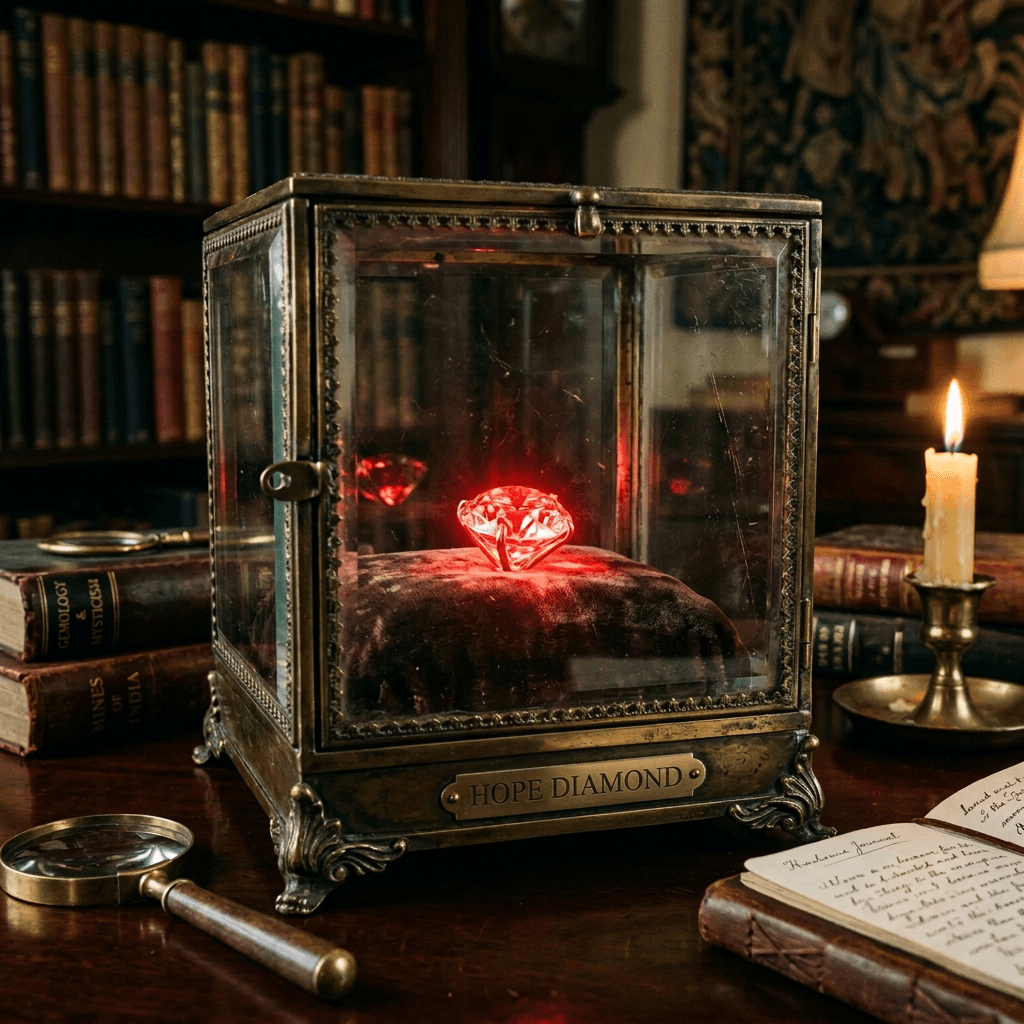
A chilling whisper echoes through history, warning that a flawless, 45.52-carat deep-blue stone will violently destroy anyone who dares to own it. The Hope Diamond, widely considered the most famous cursed diamond in the world, forces us to question a fascinating quirk of human psychology. Are these legendary gemstones actually cosmic magnets for tragedy? Or are they just highly visible symbols of raw human greed, calculated murder, and audacious theft? Let us dive headfirst into a world where dazzling luxury meets total, spine-tingling ruin!
What Is the Dark Secret of the Hope Diamond’s First True Victim?
The air in Paris, 1910, was heavy with perfume, champagne, and desperate ambition. Pierre Cartier, a masterfully cunning jeweler, sat inside a private velvet salon holding a gemstone that looked like a frozen drop of the deep ocean. He was facing the fiercely independent American mining heiress, Evalyn Walsh McLean. Evalyn was a woman who possessed hundreds of millions of dollars but lacked the one thing she craved above all else: a thrill.
Cartier leaned forward, his voice dropping to a theatrical whisper as he spun an intricate, dark romance about the jewel’s origin. He told her how a French merchant named Jean-Baptiste Tavernier had sliced the diamond straight from the glowing eye of a sacred Hindu idol in India, unleashing an ancient, fiery wrath.
“They say it brings unyielding disaster to anyone who wears it, Madame,” Cartier murmured with a calculating look in his eye.
Evalyn’s eyes flashed with defiant delight. “Bad luck objects, for me, are lucky!” she declared with a laugh, entirely captivated by the danger. She bought the stone for an astonishing $180,000, completely blind to the fact that she had just signed a contract with tragedy.
The curse did not wait long to strike. Over the next three decades, Evalyn watched her gilded world shatter into pieces. First, her beloved nine-year-old son was struck and killed by a car. Next, her husband Ned succumbed to absolute madness, drinking himself into an insane asylum where he eventually died. Then, her beautiful 25-year-old daughter took her own life with an overdose of sleeping pills. By 1947, Evalyn died broken and heavily indebted, proving that the Is the Cursed Hope Diamond a Magnet for Tragedy or Human Greed? question is more than a catchy title—it was her tragic reality.
Why Do We Blame the Gemstone Instead of Our Own Greed?
When we strip away the spooky folklore, a much more grounded, human truth begins to surface. According to scientific analysis by the Smithsonian National Museum of Natural History, where the gem securely rests today, the stone’s terrifying reputation was intentionally supercharged by clever merchants. Jeweler Pierre Cartier knew exactly what he was doing. He purposely weaponized the historic misfortunes of previous owners like King Louis XVI and Marie Antoinette—who were actually victims of the bloody French Revolution rather than a magical rock—to artificially skyrocket the diamond’s exotic allure and sales price!
Historically, super-rich elite owners used the curse as a convenient scapegoat. When gambling debts, terrible investments, or messy divorces ruined their bank accounts, it was much easier to blame a “demonic rock” than to admit their own reckless behavior. The diamond isn’t an active portal of evil energy. It is an incredibly shiny, heavy mirror that reflects the absolute worst of human obsession, extreme wealth, and unchecked vanity.
How Does Science Explain the Eerie Red Glow?
- Boron Elements: Trace amounts of boron inside the crystal structure give the diamond its stunning, rare grayish-blue color.
- Red Phosphorescence: When hit with ultraviolet light, it glows an intense, blood-red color for several seconds after the light source is turned off.
- Nitrogen Mix: Scientists at Live Science discovered that this glowing effect is caused by a unique interaction between nitrogen and boron, not spooky black magic!
- Safe Keeping: Famed jeweler Harry Winston eventually bought the McLean estate collection and safely mailed the diamond to the Smithsonian in 1958 inside a plain brown paper wrapper via standard USPS mail, effectively ending the chaotic chain of private ownership.
Ultimately, the real catastrophe isn’t a curse hidden inside the chemical matrix of a prehistoric gemstone. The true danger lies deep within the dark, insatiable depths of the human heart.
