
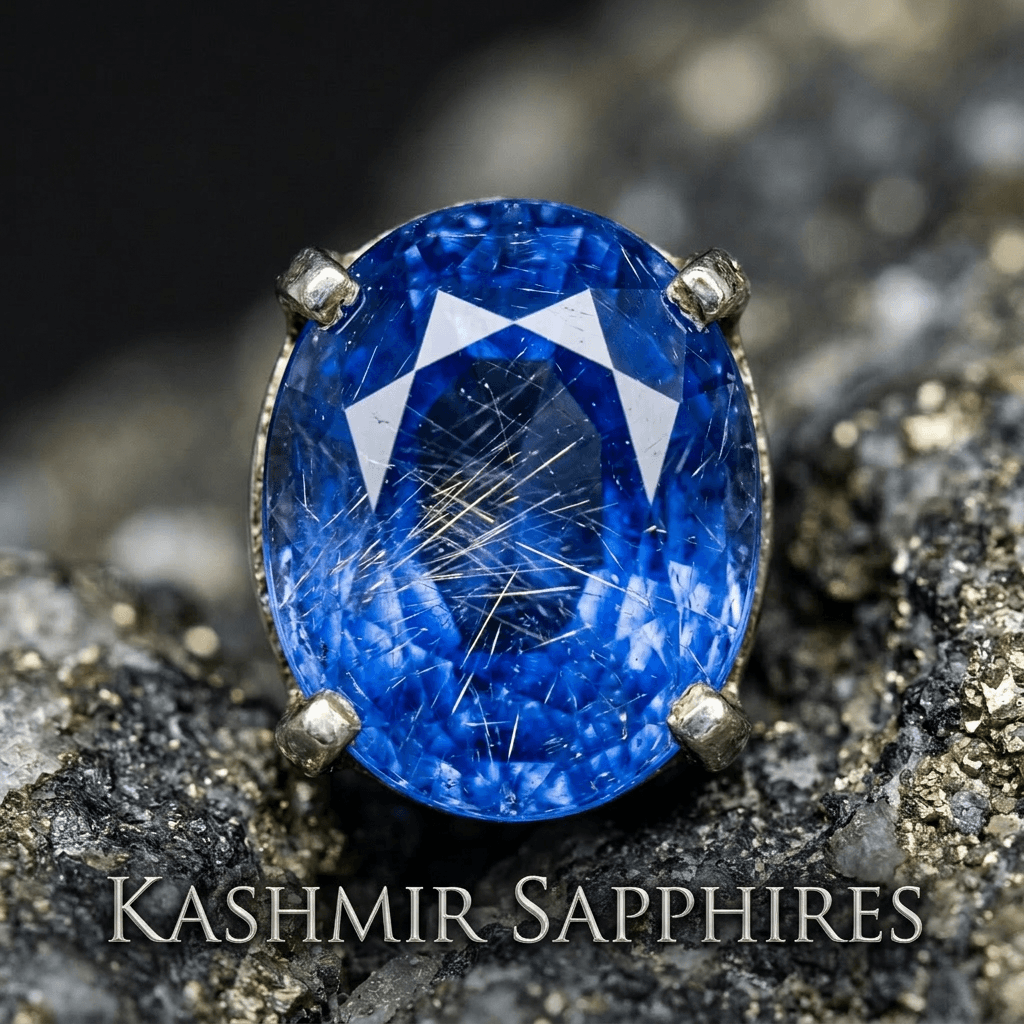
If you think diamonds are a girl’s best friend, you have clearly never locks eyes with a Kashmir sapphire, the ultimate royal flex of the gemstone world. Forget everything you know about ordinary jewelry. This blog post uncovers everything you need to know about Kashmir Sapphires: The legendary velvety-blue stones of India, a breathtaking mineral anomaly so astonishingly rare that most modern jewelers only ever see them in their wildest dreams.
These aren’t your typical dark, moody blues; we are talking about a vivid, glowing, neon cornflower hue that looks like liquid twilight trapped in crystal. Ready to discover why billionaires eagerly outbid each other at global auctions just to touch one? Grab a cup of coffee and let’s dive into the icy, high-altitude world of the most desired gemstones on Earth.
What Is the Ultimate Thriller Story Behind Their Discovery?
Imagine the biting chill of 1881, high up in the vertiginous, snow-capped Zanskar Range of the Indian Himalayas, sitting at a staggering 15,000 feet above sea level. A lonely mountain guide treks along a treacherous path when a sudden, terrifying roar echoes through the canyon. An avalanche strikes, tearing a massive chunk off the mountain cliffside.
As the blinding cloud of white snow clears, a jagged, 100-foot scar is exposed in the earth. The guide steps forward into the fresh debris, his heart hammering against his ribs, and gasps. Peeking out from the raw pegmatite rock are massive, chunked crystals glowing with an unbelievable, electric blue hue.
Local villagers from Padar initially mistake these priceless treasures for simple, everyday flint. They casually use them to start fires or sharpen crude tools!
Soon, savvy nomadic traders from Afghanistan barter for these “blue curiosities,” exchanging them in Delhi for mere bags of common table salt. When a knowledgeable gemologist finally identifies the stones as elite corundum, the financial shockwave travels straight to the royal palace. In a magnificent fury, the Maharaja of Kashmir swiftly dispatches his heavily armed royal guards. He seizes control of the remote mountain plateau, immediately halts all open trading, and demands the return of his stolen geological crown jewels. The merchants are forced to reverse every single transaction until, in a poetic twist of irony, the original traders are handed back their cheap bags of salt.
Why Do Gemologists Call Them “Velvety”?
The absolute magic of Kashmir Sapphires: The legendary velvety-blue stones of India lies within their internal, microscopic secrets. According to official lab reports from the Gemological Institute of America (GIA), these gems possess unique, sub-microscopic inclusions known as “silk”.
- Rutile Needles: These are incredibly fine, microscopic lines of titanium oxide that intersect uniformly at precise angles.
- The Flour Effect: Instead of reducing clarity, these ultra-fine particles scatter light perfectly across the stone, acting like tiny internal light reflectors.
- Sleepy Luster: This scattering creates a soft, ethereal, and distinctly “sleepy” visual texture that removes any harsh reflection.
- Day-to-Night Consistency: While other sapphires turn black or gray under weak artificial evening lights, Kashmir stones brilliantly maintain their vibrant cornflower blue under any lighting condition.
How Rare Are These Legendary Blue Gems Today?
To call these stones rare is a massive understatement—they are practically a geological myth. The historic “Old Mine” period only lasted for an exceptionally brief window from 1882 to 1887. Miners enthusiastically worked day and night through the short summer months, manually digging out stones in a dangerous environment. By 1888, the hyper-concentrated pocket of top-tier corundum was entirely depleted.
Subsequent attempts to restart regional mining on the lower valley floor yielded vastly inferior, opaque stones. In the late 1990s, political instability and illegal miners using destructive dynamite permanently ruined the structural integrity of the historic pits. Today, no new authentic material enters the open market.
Every single legitimate stone circulating in the elite jewelry world today was dug out of that single mountain over 140 years ago!
Are You Ready to Buy One?
If you are hoping to add one to your personal jewelry box, you better bring a heavy-duty suitcase packed with cash. Because of their absolute scarcity and unmatched historical provenance, they easily command the highest price-per-carat rates in the world, regularly leaving rubies and diamonds in the dust.
Recent auction archives from major houses like Christie’s highlight spectacular record-breaking bids. For instance, a premier-quality 20-carat Kashmir piece can easily fetch anywhere from six to seven figures at international venues.
When hunting for an investment piece, ensure it features independent origin verification from leading world institutions like the Swiss Gemmological Institute (SSEF) to prove it hails from the authentic Himalayan deposits. Now that you are a certified expert on Kashmir Sapphires: The legendary velvety-blue stones of India, tell us: would you trade a bag of salt for one of these bad boys?
