
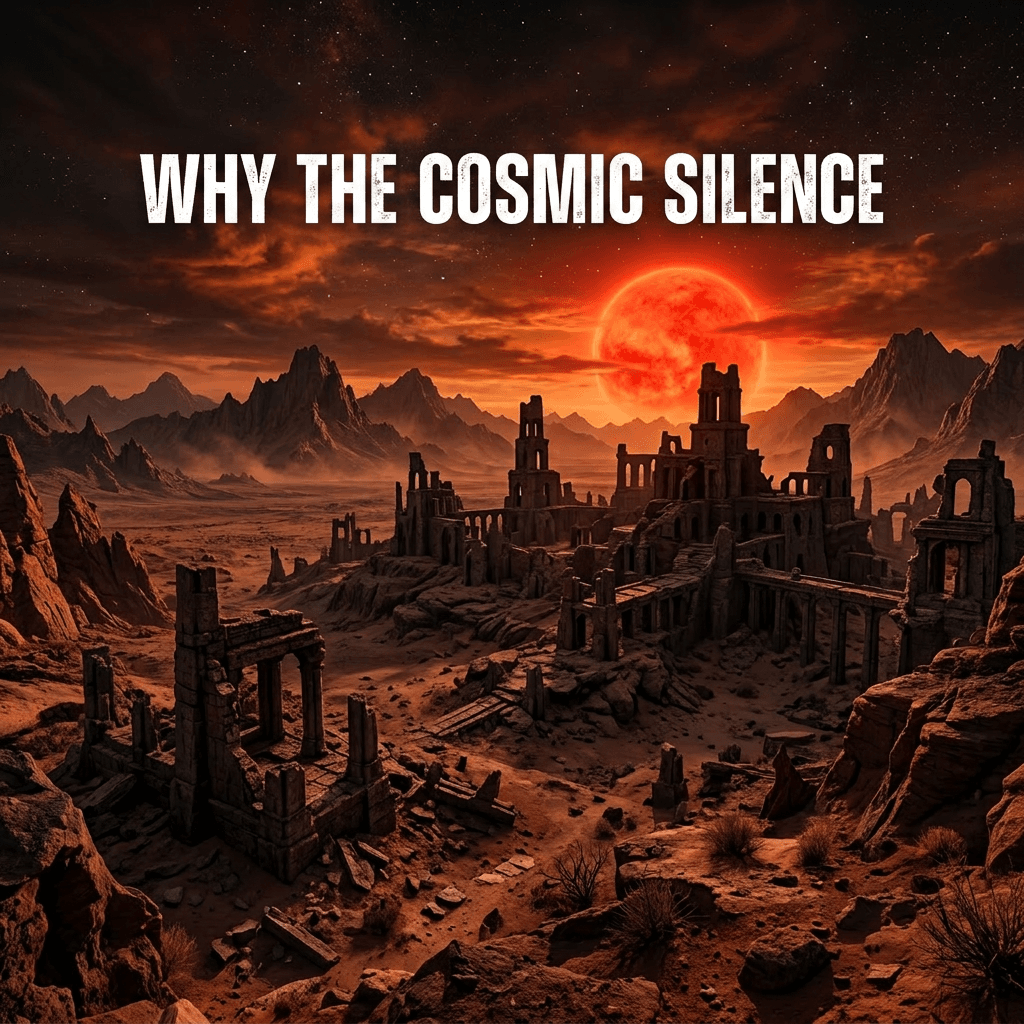
Why hasn’t anyone visited us? It is the ultimate cosmic ghost story: a universe spanning 93 billion light-years, packed with up to 2 trillion galaxies, and yet, we are met with absolute, spine-chilling silence. According to the latest data from the SETI Institute, there are an estimated 300 million potentially habitable planets in our Milky Way galaxy alone. If the cosmos is practically begging for life to flourish, why hasn’t anyone visited us to say hello?
This mind-bending contradiction is known as the Fermi Paradox, and its most terrifying resolution is a conceptual brick wall called the Great Filter. Buckle up, space travelers, because we are about to dive into the deep and outer space mysteries that dictate whether humanity will conquer the stars or perish in the dark.
Where Is Everyone in This Cosmic Haunted House?
Commander Elena Vance stared into the infinite blackness of the outer galaxy, the gentle hum of the Aegis-IV interstellar reconnaissance vessel doing little to soothe her racing pulse. For three decades, her crew had tracked a rhythmic, hyper-advanced radio signature pulsing from the habitable zone of planet GJ 3378b—a newly confirmed super-Earth located just 25 light-years away.
It was supposed to be humanity’s first official handshake with an alien civilization.
As the ship dropped out of warp and settled into a high orbit, Elena rushed to the primary viewport. Her jaw dropped. There were no flashing city lights, no orbital mega-structures, and no bustling alien fleets.
Instead, the planet’s surface was a charred, glassy obsidian graveyard, choked by an atmosphere of irradiated ash. The radio signal wasn’t a greeting. It was an automated, repeating planetary distress beacon, looping endlessly across the vacuum.
“They didn’t make it,” her science officer whispered, his voice trembling. “They hit the wall.” Elena shuddered as the chilling truth settled over the bridge. They hadn’t found neighbors. They had found another victim of the cosmic bottleneck.
What Is the Ultimate Source of the Cosmic Silence?
The foundational mystery of deep space is built on a simple question first blurted out by physicist Enrico Fermi over lunch in 1950: “Where is everybody?”
Consider the mathematics. The universe is roughly 13.8 billion years old. Our own solar system is a relative newcomer, forming just 4.5 billion years ago. If it takes less than a few tens of millions of years for a highly motivated civilization to colonize an entire galaxy using sub-light speed travel, the Milky Way should have been conquered millions of years before humans even learned to walk upright.
Yet, when projects like the FAST Telescope sweep the heavens, they find zero trace of astro-engineering, Dyson spheres, or alien colonizers. The question why hasn’t anyone visited us isn’t just an existential puzzle; it is a statistical anomaly that demands a structural answer.
How Does the Great Filter Solve the Fermi Paradox?
To solve this glaring contradiction, economist Robin Hanson introduced the Great Filter theory. This hypothesis posits that somewhere along the timeline from a cold, dead rock to a Type III galaxy-spanning super-civilization, there is an evolutionary barrier so insanely difficult to pass that it filters out almost all intelligent life.
Think of it as a brutal, multi-stage cosmic survival game. The steps required to build an interstellar empire include:
- Abiogenesis: The spark where non-living chemistry creates basic, self-replicating life.
- Eukaryotic Transition: Simple single-celled organisms evolving into complex, multi-cellular life.
- Tool Utilization: The development of intelligent species capable of manipulating their environment.
- Technological Achievement: Advancing to the point of spaceflight and radio communication.
- Interstellar Expansion: Colonizing other star systems without destroying yourself in the process.
If any one of these steps is functionally impossible, the universe stays dead silent.
Are We Safely Past the Danger Zone, or Is the Worst Yet to Come?
The most crucial question for human survival is determining exactly where this evolutionary bottleneck sits on our timeline. There are only two realistic scenarios, and both will completely alter how you look at the night sky.
Scenario 1: The Filter Is Behind Us (We Are the Chosen Ones)
In this highly optimistic view, the evolutionary bottleneck is an event in our deep biological past. According to an evolutionary analysis published in early 2026 on Preprints.org, the filter might have been the incredibly rare planetary collision that formed our Moon and kicked off Earth’s active plate tectonics.
If creating complex life or developing plate tectonics is an astronomical one-in-a-trillion miracle, then humanity is the first species to ever beat the cosmic odds. We are alone simply because we are the galactic pioneers.
Scenario 2: The Filter Is Ahead of Us (The Cosmic Death Trap)
This is the ultimate existential nightmare. If astronomers discover that basic microbial life or ruined alien ruins are common throughout deep space, it means the bottleneck is waiting for us in our immediate future.
Once a species unlocks the laws of physics, it simultaneously creates the tools for its own extinction. The upcoming walls we must dodge include:
- Nuclear Annihilation: Global warfare wiping out technological capability.
- Runaway Artificial Intelligence: Superintelligence misaligning with biological life.
- Engineered Pandemics: Weaponized gene-editing escaping containment.
- Asymptotic Burnout: Civilizations giving up on space travel, choosing to shrink their populations and live sustainably at home.
If the filter lies ahead, every civilization hits the technological ceiling, flashes briefly like a dying match, and returns to silent dust.
How Do We Keep Humanity from Hitting the Cosmic Wall?
If we want to ensure that future alien species never look at Earth and ask why hasn’t anyone visited us, we have to proactively conquer the filter. The answer lies in urgent, aggressive scientific diversification.
We must accelerate the search for biosignatures using tools like NASA’s Nancy Grace Roman Space Telescope to find out if other worlds are alive. Concurrently, we must establish permanent, self-sustaining colonies on the Moon and Mars. By backing up our civilization on multiple planets, we ensure that a single localized catastrophe can never wipe out the entire human legacy. The cosmos is waiting—and it’s time to prove we can survive it.
