
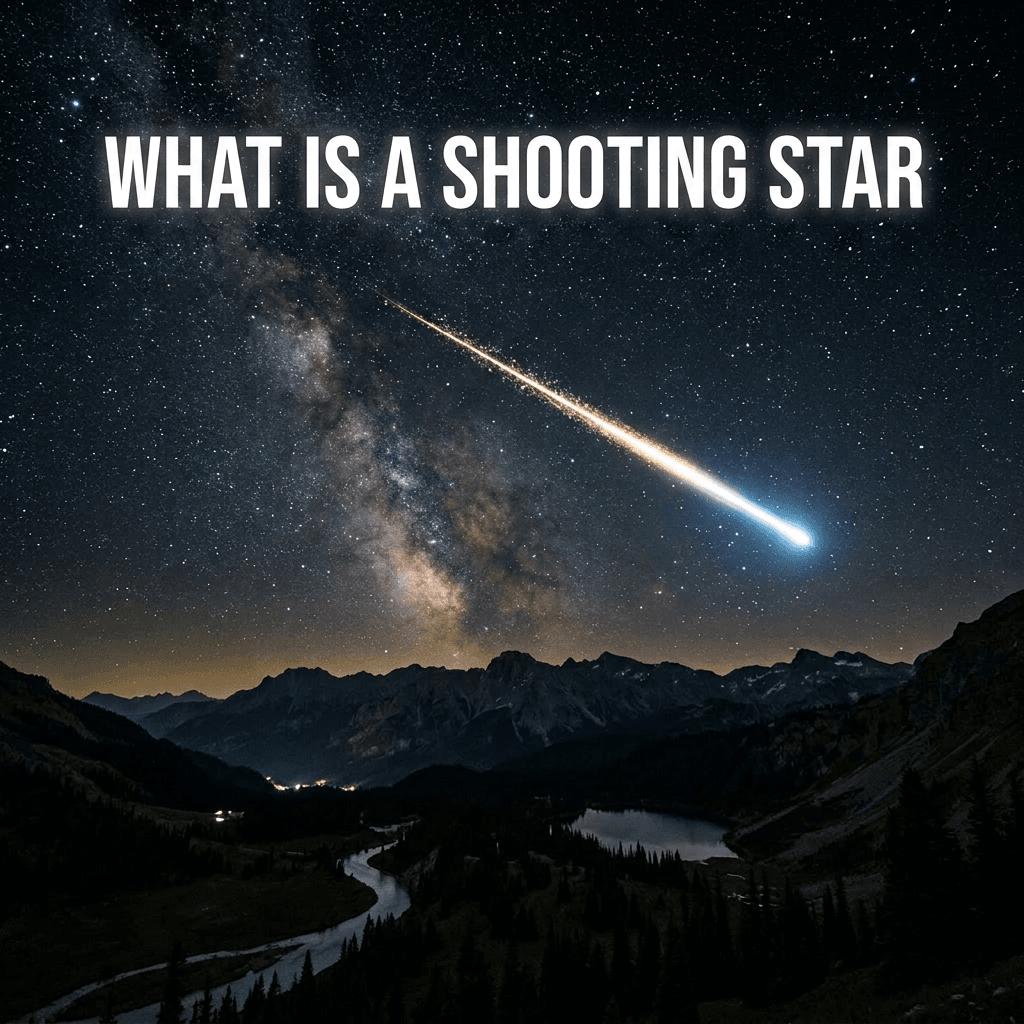
You are staring at the midnight sky when a brilliant streak of light tears through the dark, making you gasp before it vanishes forever. Was it an alien spaceship, a cosmic tear, or magic? Everyone loves making wishes on them, but do you actually know what is a shooting star? Prepare to have your mind completely blown because these dazzling streaks have absolutely nothing to do with actual stars.
Let us dive right into a pulse-pounding, suspenseful tale from the edge of our atmosphere. High above us, a tiny, lonely particle named Leo had been drifting through the freezing void of outer space for four billion years. Leo was a quiet space rock, minding his own business near an ancient asteroid belt. Suddenly, the massive gravitational pull of Earth caught him in a deadly snare! Dragged from the peaceful dark, Leo began falling toward Earth at a terrifying speed of 45 miles per second. The air became a wall of extreme pressure. Leo compressed the gases in front of him so violently that the air began to glow with white-hot, furious heat. In a brilliant, agonizing flash of glory, Leo transformed into a spectacular streak of light, sacrificing his outer cosmic shell to illuminate the night sky for a pair of amazed structural stargazers below.
Why Do People Call It a Shooting Star?
The phrase what is a shooting star traces back to ancient human history when watchers of the night sky lacked high-tech telescopes. To ancient astronomers, these sudden, blinding paths of light looked exactly like a star breaking free from the celestial fabric and firing across the heavens. However, real stars are massive, burning balls of gas located light-years away, while a shooting star happens right in our cosmic backyard. According to the NASA Space Place educational hub, these events occur entirely within Earth’s upper atmosphere, specifically in a layer called the mesosphere
What Is the Real Scientific Definition?
The exact scientific name for this stunning visual event is a meteor. The physical object itself, while still tumbling through the cold vacuum of outer space, is called a meteoroid.
Most meteoroids are incredibly small, often no larger than a tiny grain of sand or a small pebble. When you ask what is a shooting star, you are physically asking about the glowing trail of superheated air surrounding a space rock as it undergoes ablation.
How Does a Meteoroid Turn Into a Burning Light Streak?
It is all about extreme speed and intense atmospheric friction. When a meteoroid strikes Earth’s atmosphere, it travels so fast that it forcefully compresses the air molecules ahead of it.
This compression creates intense heat, reaching temperatures over 3,000 degrees Fahrenheit. The American Meteor Society guides clarify that this extreme heat vaporizes the rock, creating a bright path of glowing ionized gas that we see from the ground.
What Is the Difference Between a Meteor, Meteoroid, and Meteorite?
The naming system depends entirely on the physical location of the space debris:
- Meteoroid: The rock while it is still drifting out in deep space.
- Meteor: The brilliant streak of light visible in the sky as the rock burns.
- Meteorite: Any surviving fragment that manages to land on Earth’s surface.
Where Does This Cosmic Space Debris Originally Come From?
Most of these rogue space fragments are crumbs left behind by melting comets or colliding asteroids. As a comet travels close to the Sun, it sheds a massive trail of icy dust and rocky debris.
When Earth orbits directly through these dusty trails, we experience a spectacular phenomenon known as a meteor shower. The Royal Museums Greenwich astronomy logs show that events like the annual Perseids can produce dozens of visible shooting stars every single hour!
Can a Shooting Star Ever Turn Dangerous For Earth?
Fortunately, almost all meteoroids are completely vaporized long before they ever reach the ground. The friction of our protective atmosphere acts as a giant cosmic shield against outer space debris.
Only very large space rocks survive the fiery descent to become meteorites. So, you can keep looking up at the night sky and enjoying the view without any fear of cosmic interference!
