
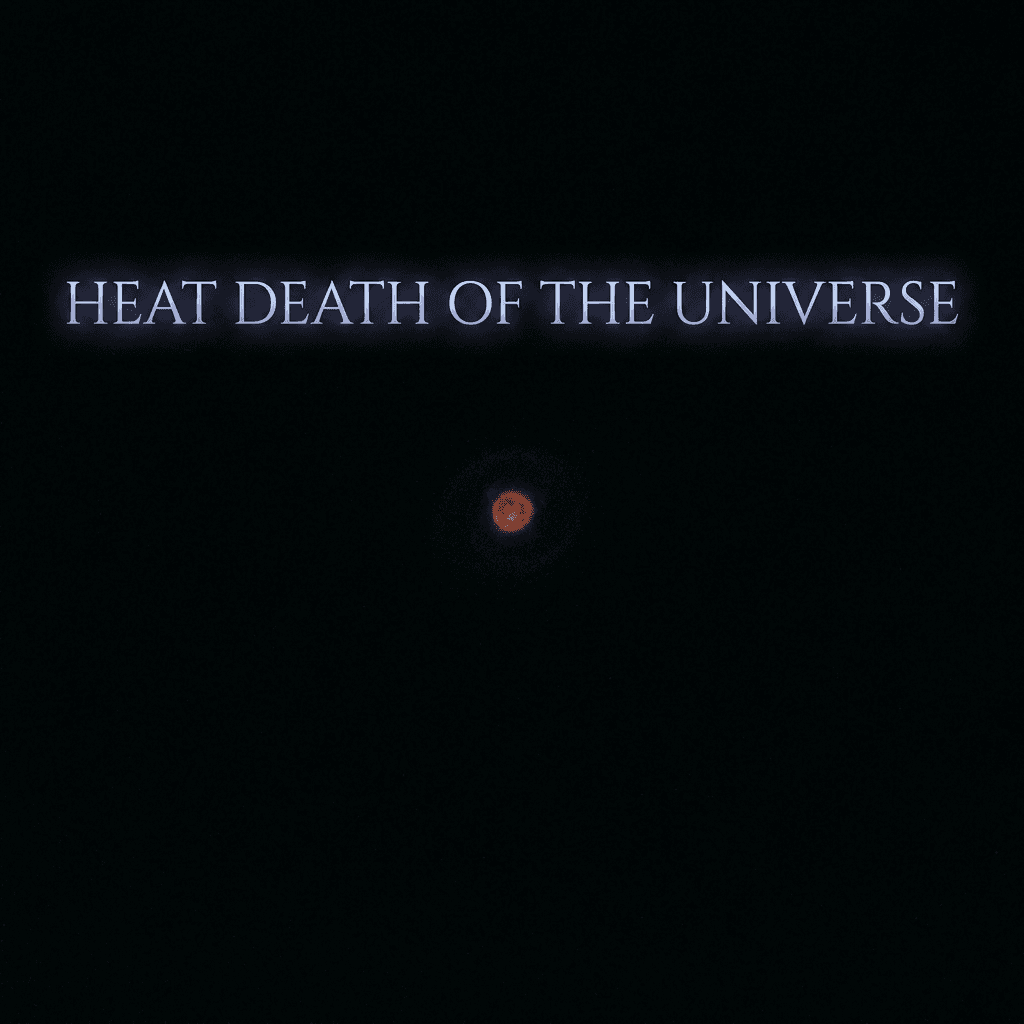
The entire universe is slowly running out of battery, and there is absolutely nothing you can do to plug it back in. Welcome to the ultimate existential countdown. It is cosmic, it is unavoidable, and it is beautifully terrifying. Today, we are deep-diving into The Ultimate Guide to the Heat Death of the Universe to see exactly how our cosmic home will meet its final, silent end.
What is the Heat Death of the Universe?
Imagine a cosmic love story where the two lovers are destined to drift so far apart that they forget each other’s names. Once upon a time, billions of years ago, a blazing, passionate event called the Big Bang birthed everything we see, taste, and touch. Space and time exploded into existence with endless energy.
But according to the foundational laws of physics, this frantic romance has a strictly enforced expiration date. The cosmos is expanding constantly, stretching its fabric wider by the second. As it expands, it cools. Stars burn through their nuclear fuel like frantic candles in a dark room. Eventually, every single star will exhaust its supply and flicker out into total darkness.
Even the terrifying, monumental black holes will slowly lose their mass over trillions of years through a process known as Hawking radiation, eventually evaporating into nothingness. All matter will decay into its most basic subatomic particles. The universe will reach maximum entropy—a state of ultimate equilibrium where heat is perfectly evenly distributed, rendering it a cold, motionless, uniform expanse. There will be no light, no motion, and no life. It is the perfect, chilly, everlasting sleep of existence.
Why Does Maximum Entropy Mean Game Over?
Have you ever wondered why you can’t unscramble an egg once it is cooked? That is entropy at work, and it is the strict master of our cosmic destiny. The Second Law of Thermodynamics dictates that the total entropy, or disorder, of an isolated system will always increase over time.
Think of energy like water flowing down a mountain. It can do useful work while it falls, turning waterwheels and generating power. But once all the water reaches the bottom of the valley and pools into a flat, still lake, it can no longer flow. The energy is still there, but it is completely trapped.
When the cosmos reaches maximum entropy, all energy becomes completely uniform. Because there are no differences in temperature, no heat can transfer. Without heat transfer, no thermodynamic work can happen. No engines can purr, no chemical reactions can spark, and no alien civilizations can write poetry. The universe effectively freezes in place forever.
How Long Do We Have Until the Lights Go Out?
Are you panicking about your weekend plans being ruined by cosmic annihilation? You can breathe a sigh of relief because this ultimate freeze takes an unimaginably long time. Scientists estimate that the star-forming era will end in about 100 trillion years.
After that, the universe enters the “Degenerate Age,” where only dead stellar remnants like white dwarfs and neutron stars remain. The “Black Hole Age” follows, lasting up to \(10^{100}\) years as black holes slowly rule—and then evaporate across—the empty void.
To put that into perspective, the current age of our universe is merely a tiny, microscopic fraction of its total lifespan. We are living in the absolute prime, golden morning of existence. The final, uniform dark age lasts for an infinity that human minds cannot even fully fathom.
Can Anything Stop This Frozen Cosmic Destiny?
Is there a secret escape hatch or a cosmic undo button to save us from this chilly fate? The short, definitive answer based on modern astrophysics is no.
The expansion of the universe is actually accelerating, driven by a mysterious force known as dark energy. Unless dark energy changes its behavior unexpectedly in the distant future, the expansion will continue completely unchecked. Some theoretical physicists have proposed wild, sci-fi ideas like escaping into parallel dimensions through artificial wormholes, or generating artificial mini-universes. But within our own cosmic bubble, the ultimate trajectory toward a cold, uniform expanse remains completely unyielding. The heat death is the definitive, poetic period at the end of the grand cosmic sentence.
