
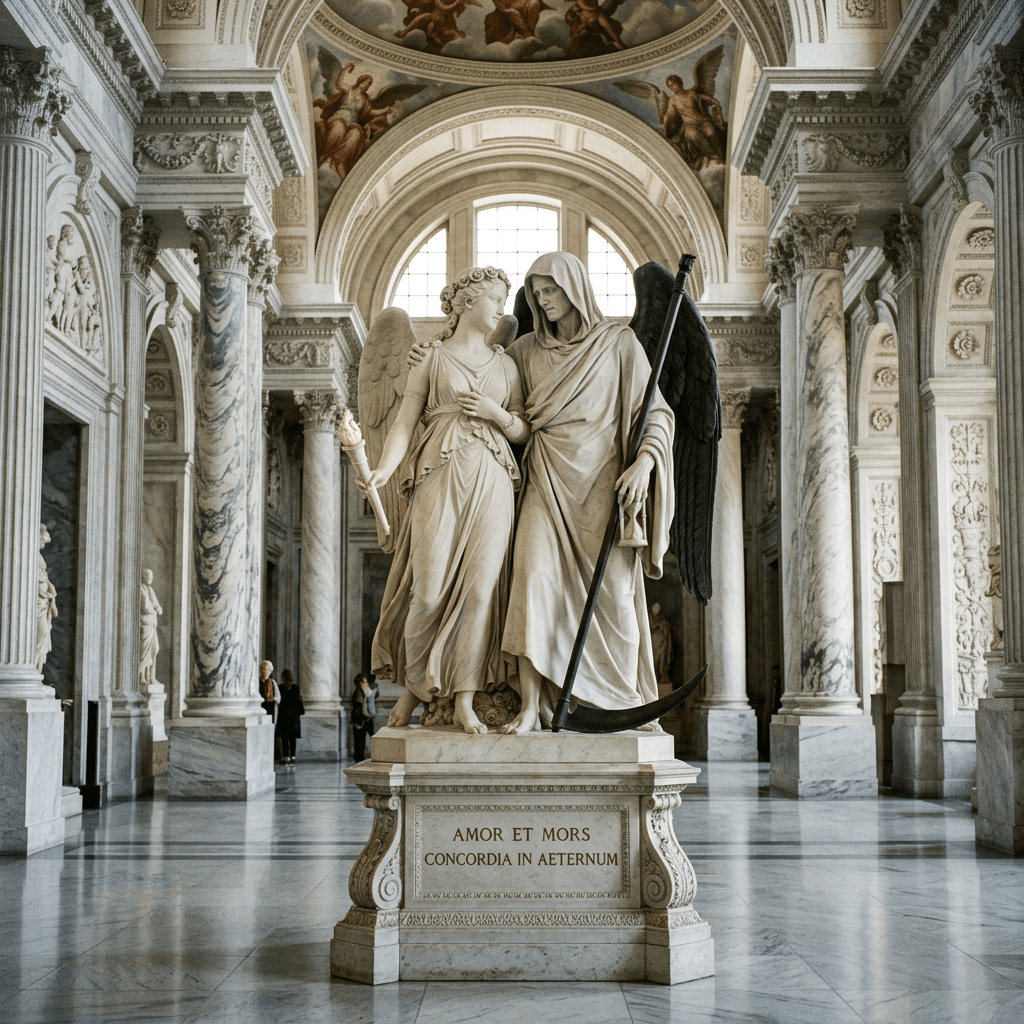
Blood pooled beneath her fractured ribs like spilling wine, yet Francesca smiled because his lips were still pressed against her dying breath. They were pierced through the heart by a single, vengeful blade, bound together in a final, agonizing embrace. This is the inescapable reality of Eros and Thanatos, the psychological tug-of-war between the life-giving drive of love and the inevitable pull of death. In the world of masterwork paintings and legendary lore, this duality isn’t just common—it is the ultimate aesthetic peak. If you have ever felt your heart race at a doomed romance, you are already under the spell of this eternal conflict. Let us explore the tragic beauty of Eros and Thanatos to discover why art cannot live without the presence of death.
Who Are Eros and Thanatos in Classic Mythology?
Long before they became icons of art history, these two forces were recognized as Greek primordial deities. Eros represents the instinct of life, passion, creation, and sexual desire. Conversely, Thanatos personifies peaceful death, decay, and the ultimate end of consciousness. Sigmund Freud famously popularized these terms in his psychological framework, Beyond the Pleasure Principle, proving that humans are permanently torn between the drive to create life and an unconscious urge to return to a state of calm oblivion. When these two cosmic principles collide, they create a friction so intense that it has inspired humanity’s greatest creative masterpieces for centuries.
Why Does Doomed Romance Fascinate Us So Deeply?
There is an undeniable, addictive thrill in watching a love story that is destined to burn to ashes. Safe, comfortable, happily-ever-after romances rarely evoke the raw, visceral responses triggered by absolute tragedy. When love is forbidden or doomed, the emotional stakes skyrocket to a cosmic level. The omnipresence of mortality strips away the mundane distractions of daily life, leaving behind an unfiltered, hyper-concentrated expression of human devotion. This dangerous intersection of passion and peril forces us to confront our own mortality while celebrating the one force capable of defying it.
How Did Paolo and Francesca Become Eternal Icons of Passion?
To truly comprehend how Eros and Thanatos rule the canvas, we must look at the devastating tale of Paolo and Francesca. Immortalized in Dante’s Inferno, Francesca da Rimini was trapped in a political marriage to a cruel man, but she fell hopelessly in love with his handsome brother, Paolo Malatesta. One afternoon, while reading a romance novel together, their hidden passions overflowed into a forbidden kiss. Francesca’s husband caught them in the act and immediately slaughtered them both on the spot.
Artists throughout history have been obsessed with capturing this exact flashpoint where supreme love meets sudden execution. For instance, the French painter Auguste Rodin sculpted The Kiss as a direct physical monument to their eternal, illicit embrace. Similarly, the dramatic canvas by Jean-Auguste-Dominique Ingres portrays the terrifying moment the husband draws his sword while the lovers remain suspended in pure ecstasy. They are cast down into the second circle of hell, condemned to be buffeted by violent, eternal winds for all time. Yet, their true victory is that they are forever locked in each other’s arms, proving that their Eros successfully weaponized Thanatos into an immortal monument of defiance.
Where Else Do Love and Death Merge in Art History?
The tragic symmetry of Eros and Thanatos extends far past Dante’s vision and saturates the entire timeline of human expression. Consider Shakespeare’s Romeo and Juliet, where the ultimate declaration of romantic devotion can only be consummated through a double suicide inside a dark, cold tomb. In the realm of visual arts, John Everett Millais’ painting Ophelia captures Hamlet’s discarded love floating down a stream, surrounded by symbolic wildflowers as she surrenders to a watery grave. Her expression is not one of panic, but of a serene, almost erotic surrender to the void.
Even the legendary AIOSEO Title Tag Best Practices highlight how a powerful, dramatic narrative hook captures human attention exactly like a masterpiece painting does. By wrapping the finality of death around the infinite nature of love, artists create a paradox that ensures their subjects will never be forgotten.
How Can You Embrace This Aesthetic in Your Own Life?
You do not need to meet a tragic end in a dungeon to appreciate the dark, romantic energy of Eros and Thanatos. Start by introducing the dramatic contrast of light and shadow—known in art history as chiaroscuro—into your personal style and home decor. Pair deep, velvety crimsons and midnight blacks with delicate, romantic textures like lace and silk. Visit your local galleries to actively seek out historical narratives that challenge your emotions. By acknowledging that life is fleeting, every ounce of passion, creativity, and love you express becomes infinitely more valuable. Live boldly, love fiercely, and let the tragic beauty of art inspire your everyday journey!
