Composition will completely change how you view visual masterpieces, but only if you are ready to uncover the hidden codes of artistic perfection! The art of symmetry harnesses the captivating power of balance, reflection, and repetition to create harmonious and visually satisfying masterpieces. Symmetrical art celebrates the aesthetic appeal of order and equilibrium, inviting viewers to explore the beauty found in mirrored compositions. Our brains are hardwired to love this visual harmony, making it one of the most powerful tools in any artist’s creative arsenal.
Let us dive deep into a thrilling, high-stakes artistic journey to reveal exactly why your eyes crave this flawless structure.
Why Did the Master Painter Risk Everything for Absolute Perfection?
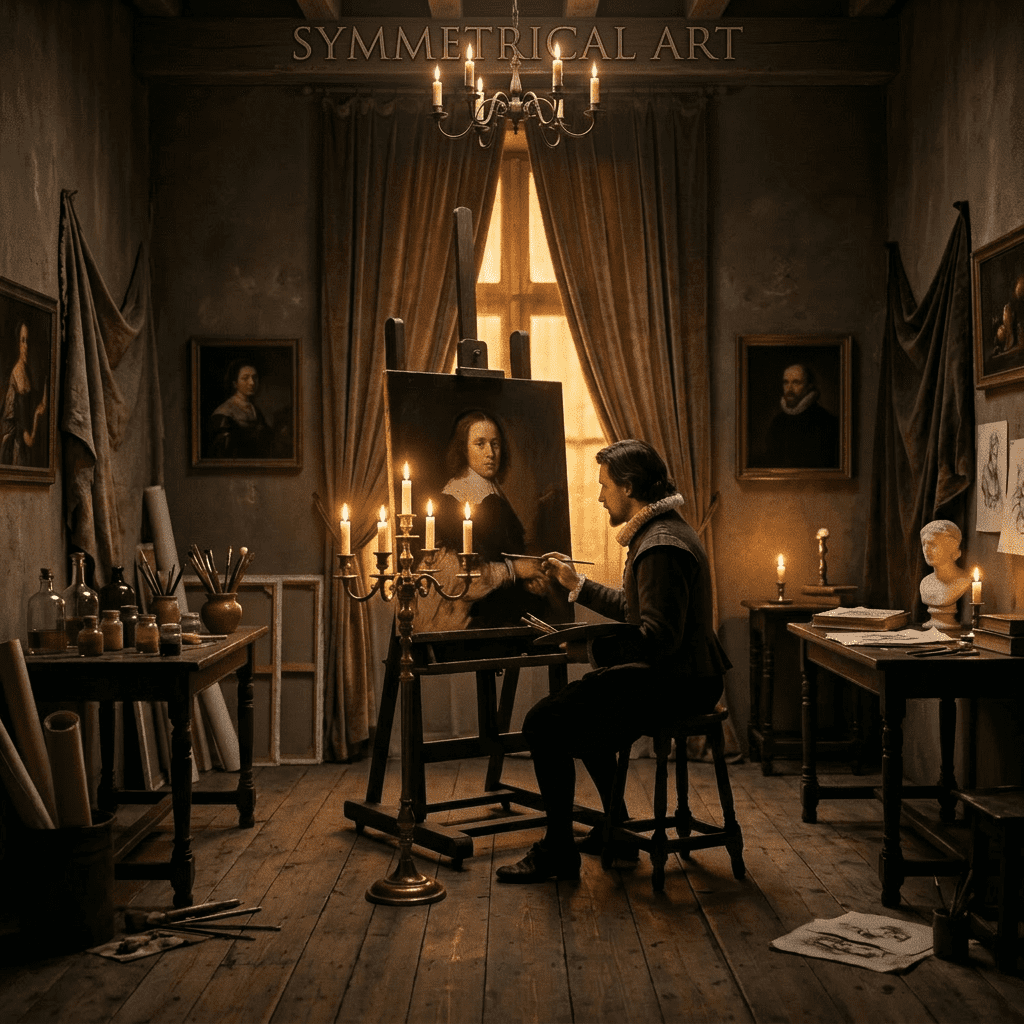
The candle flickered wildly in the damp, stone-walled studio as Julian stared at his canvas, his hands trembling with exhaustion. It was 3:00 AM, and the Grand Exhibition was only six hours away. If his final masterpiece was anything less than perfect, his rival, Lord Vane, would ensure Julian was banished from the Royal Art Academy forever. Julian raised his brush, his eyes tracking the precise vertical axis of his central figure.
“One millimeter to the left,” a voice hissed from the shadows.
Julian spun around. It was Vane, holding a vial of black ink, ready to ruin the work. “Your composition is flawed, Julian! It lacks the divine order!”
“No, it does not,” Julian whispered, stepping between Vane and the canvas. “It utilizes symmetrical art to capture the human soul.”
Vane lunged forward, tipping the ink vial. Julian blocked him, throwing his weight to the right, mimicking Vane’s movement in a desperate, physical dance of absolute equilibrium. The ink splashed to the floor, forming a perfectly mirrored pool between them. Vane stared down, mesmerized by the accidental reflection, paralyzed by its sudden harmony. Julian took advantage of the distraction, grabbed his brush, and added the final, identical brushstrokes to both sides of the canvas. The visual balance was completed, saving Julian’s career and redefining how the academy viewed structural beauty.
How Does Symmetrical Art Trick Your Brain Into Feeling Peace?
Have you ever wondered why looking at a perfectly mirrored design instantly lowers your heart rate? Cognitive psychologists note that the human brain processes mirrored images with extreme cognitive fluency according to NCBI. Because the left and right sides match, your visual cortex expends less energy decoding the scene.
This evolutionary shortcut translates directly into an emotional sense of tranquility and order. When an artist utilizes a vertical axis, our eyes intuitively lock onto the center, creating a hypnotic focal point that commands attention.
Which Famous Historical Masterpieces Perfected This Visual Balance?
History is packed with legendary creators who relied on exact balance to make their work immortal. Consider these premier examples of symmetrical art:
- The Last Supper: Leonardo da Vinci arranged the disciples in meticulous, overlapping groups of three on either side of Jesus. This precise technique draws the viewer’s eye directly to the center. You can study this intentional framework through the historical analysis on YourArtPath.
- The Vitruvian Man: This world-famous ink drawing proves how human anatomy mirrors geometric stability.
- Sacred Mandalas: Used across Eastern traditions, these circular, multi-axis designs represent the cosmic order. They serve as visual tools for meditation and spiritual alignment.
What Are the Core Types of Balance You Can Use Today?
To master this aesthetic style, you must understand the different ways an artist can manipulate space:
- Bilateral Symmetry: A direct mirror reflection across a single central line, usually vertical.
- Radial Symmetry: Elements radiate outwards from a singular central point, like a snowflake or a cathedral rose window.
- Translational Symmetry: Repeating a specific visual element or pattern across a flat plane, often seen in grand architecture.
By embracing these principles, you can create compositions that feel stable, authoritative, and profoundly beautiful.
