
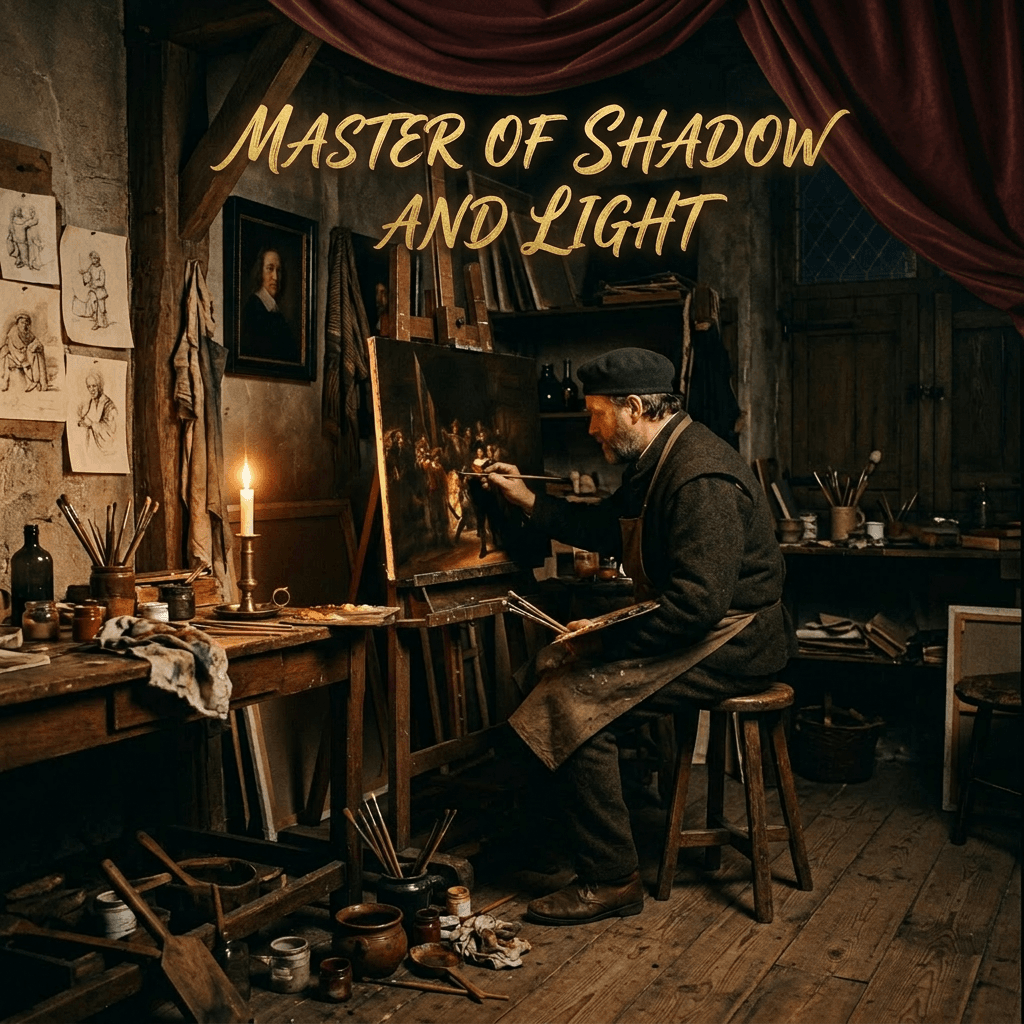
A single, guttering candle blade stabs through the suffocating ink of an Amsterdam night, illuminating a face etched with the wreckage of a forgotten empire. You are not just staring at a canvas; you are breathing the stale, chilly air of a 17th-century studio, trapped in a timeless tug-of-war between blazing glory and absolute darkness. This isn’t basic oil painting—this is high-stakes human drama, orchestrated by the undisputed king of Baroque intensity. If you have ever wanted to pull back the velvet curtain on history’s most fascinating creative rebel, you are in the right place. Let’s dive deep into The Secret of Rembrandt Chiaroscuro: Master of Shadow and Light! to discover how one man turned raw pigment into pure psychological warfare.
Why Did the Golden Boy of Amsterdam Choose total Ruin?
The year is 1642, and the cobblestone streets of Amsterdam hum with the gossip of wealthy merchants. Inside a lavish mansion on Jodenbreestraat, Rembrandt van Rijn stands before his monumental masterpiece, The Night Watch, wiping a streak of lead white across his apron. He is the top-earning portrait artist in the Dutch Republic, a compulsive collector of rare antiquities, and a man deeply, fiercely in love. His beautiful wife, Saskia van Uylenburgh, has been his ultimate muse, her golden hair and soft smile radiating through his early, brightly lit canvases.
But death is a cruel shadow that cares nothing for artistic genius.
Saskia lies in the master bed, her breath rattling like dry leaves as tuberculosis ravages her young body. Rembrandt rushes to her side, charcoal flying across paper in a desperate, heartbreaking attempt to anchor her fleeting soul to the physical world. When her eyes finally close forever at the tragic age of 29, the brilliant light in Rembrandt’s world snaps out.
Grief-stricken and shattered, he abandons oil painting for years, plunging into a self-destructive spiral of reckless spending, scandalous affairs, and bitter lawsuits. He fights with his son’s wetnurse, gets dragged before the Calvinist Church, and stubbornly buys back his own art prints at astronomical prices even as his debts mount. By 1656, the unthinkable happens: the wealthy superstar files for insolvency, a strategic form of bankruptcy.
The court orders a ruthless auction of his beloved treasures—his Renaissance paintings, exotic weapons, and ancient sculptures are stripped away. Eventually, he is driven so deeply into poverty that he is forced to sell Saskia’s very grave plot just to buy food. Yet, standing in the cold ruins of his former life, surrounded by a dark void, Rembrandt grabs his brushes with trembling, defiant hands. He realizes that while he has lost his fortune, his status, and his true love, he has unlocked something far greater: the ultimate emotional honesty of the Rembrandt chiaroscuro style.
How Does Rembrandt Chiaroscuro Weaponize Light and Shade?
To truly appreciate his genius, you have to look closely at how the Rembrandt chiaroscuro technique completely rewrote the rules of the art world. Derived from the Italian words for bright (chiaro) and dark (oscuro), this method uses intense, high-contrast lighting to give flat canvases a realistic, three-dimensional volume. While his predecessor Caravaggio used harsh light to emphasize external, theatrical action, Rembrandt used it to uncover the mysterious, glowing interior of the human soul.
According to the comprehensive database at The Art Story, his technical evolution directly mirrored his personal trauma. Instead of smoothly painting flat portraits under even, artificial illumination, he engineered a revolutionary “spotlight” effect. He would place his primary light source high and to one side of his subject, casting the majority of the scene into thick, opaque shadows.
This precise positioning creates a brilliant, signature triangle of light right beneath the eye on the shaded side of the face. Today, portrait photographers and Hollywood cinematographers still officially call this setup “Rembrandt lighting”. He didn’t just paint what people looked like; he used structural shadow to guide your eyes straight to the heavy burdens, hidden secrets, and quiet resilience of his subjects.
What Secrets Are Hidden in the Master’s Thick Paint?
If you step close to a late Rembrandt painting at a world-class institution like the Rijksmuseum, you will notice it looks remarkably messy up close. He abandoned the smooth, polished finishes popular during the Dutch Golden Age. Instead, he pioneered a heavy impasto technique, slapping down thick, textured layers of lead white and earth-toned pigments with coarse brushes and palette knives.
Recent microscopic research highlighted by the University of Amsterdam reveals that Rembrandt strategically manipulated chemical compounds like yellow ochre and smalt to create an optical illusion known as the simultaneous contrast effect. By placing identical pigments into contrasting light and dark zones, he made his painted highlights appear to physically radiate light from within the canvas. The raised ridges of his thick paint catch the actual, ambient light of the room, throwing micro-shadows across the artwork and giving the human skin a living, breathing texture.
Ready to Bring the Baroque Drama into Your Creative World?
Now that you know how the master turned personal tragedy into visual triumph, it is your turn to channel that raw energy. Look at his incredible journey documented by the Rembrandt House Museum—he proved that true art isn’t about chasing shallow perfection; it’s about embracing the contrast of your heaviest shadows to make your brightest light truly shine.
Go grab a flashlight, position it at a sharp angle to your subject, and watch that iconic, dramatic diamond of light appear under the eye. Whether you are setting up a dramatic photoshoot, sketching in your studio, or just redecorating your space, mixing bold contrast will instantly elevate your work from boring to breathtaking. Don’t let your creative ideas fade into a flat, safe background. Drop a comment below telling us which Rembrandt masterpiece inspires you the most, and go create something unforgettable today!
