
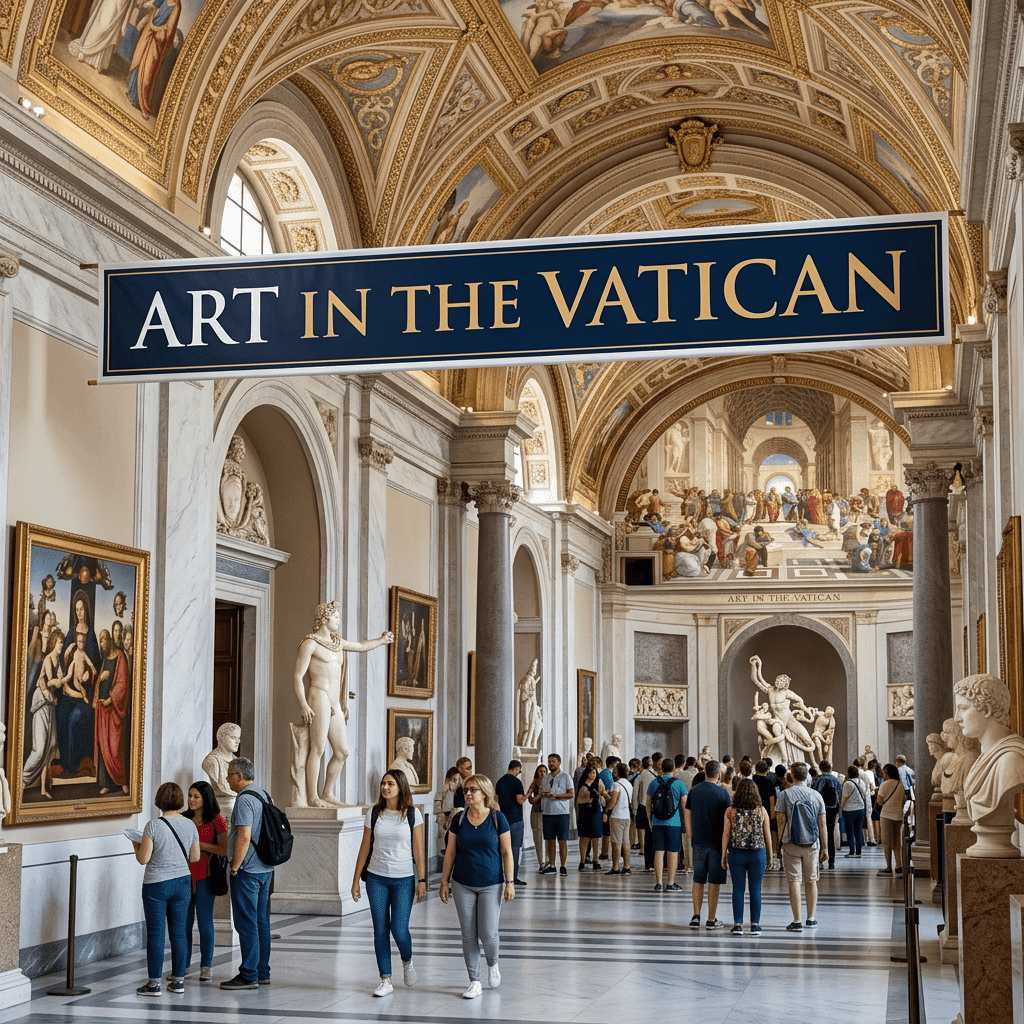
If you want to experience a visual shockwave that will permanently alter your worldview, you need to book a flight to Rome immediately. Tucked inside the borders of the world’s smallest city-state is a jaw-dropping, palatial fortress holding centuries of pure aesthetic dominance. We are talking about the quality of art in the Vatican. Far from being just a collection of historical religious relics, this sacred archive is a high-octane arena of political rivalry, raw artistic obsession, and unmatched creative execution.
Forget about boring, quiet museum tours where people whisper in front of dusty canvases. Diving into the quality of art in the Vatican means entering a high-stakes, ruthless playground where Renaissance masters literally put their sanity, health, and lives on the line to achieve perfection. It is a space where every frescoed wall, marble statue, and gilded ceiling was engineered by popes and prodigies to broadcast an aura of absolute, undisputed authority. Here is your detailed, high-utility blueprint to navigating the greatest cultural treasure chest on Earth, featuring a dramatic, suspenseful history story that proves why these masterpieces are practically forged in fire.
How Did a Backstabbing Architectural Plot Backfire Into the Greatest Masterpiece on Earth?
To truly comprehend the cutthroat energy fueling the quality of art in the Vatican, we have to slip into the moonlit corridors of the Apostolic Palace back in 1508. Imagine a young, cocky, hyper-successful painter named Raphael whispering malicious advice into the ear of Pope Julius II. Alongside his conspirator Bramante, Raphael wanted to completely humiliate a bitter rival who was fast-tracking his way to papal favor—a sculptor who had barely ever picked up a paintbrush named Michelangelo Buonarroti.
Suddenly, a trap was sprung: Bramante convinced the Pope to force Michelangelo to paint the massive, 12,000-square-foot ceiling of the Sistine Chapel. Instead of a prestigious honor, this was a calculated, toxic trap designed to set Michelangelo up for total public failure. They knew he was a sculptor at heart, and they fully expected him to crash and burn, destroying his reputation while leaving the path to papal millions completely clear for Raphael.
The tension in the Vatican was an absolute pressure cooker of suspense and professional sabotage! Michelangelo furiously rejected the assignment at first, screaming that he was not a painter, but the iron-willed Pope left him with zero choice. Consequently, locked inside the chapel for four brutal years, Michelangelo turned his rage into raw creative weaponization. He built his own complex scaffolding, worked in blinding darkness, and painted suspended upside down as toxic wet plaster dripped directly into his eyes, destroying his vision.
Bramante and Raphael sneaked into the chapel halfway through construction, and their jaws hit the marble floor. The sheer, mind-blowing scale, anatomical perfection, and dynamic energy of the ceiling was a triumph that completely redefined the limits of human capability. This dramatic betrayal proved that the breathtaking quality of art in the Vatican wasn’t born out of peaceful meditation; it was forged through fierce rivalry and an unyielding refusal to be destroyed by your enemies. As a result of that backstabbing plot backfiring, Michelangelo cemented his name as an immortal titan, while the Vatican secured a masterpiece that still leaves millions of visitors completely speechless today.
What Absolute Heavyweights Dictate the Unmatched Caliber of the Vatican Collections?
Moving forward from that high-stakes Renaissance drama, let’s look at the hard-hitting metrics that define the world-class status of these galleries. When you step inside the Vatican Museums, you are looking at a historic footprint spanning over five miles of continuous exhibition space housing roughly 70,000 individual artifacts.
To conquer this labyrinth like an absolute pro and appreciate the pure quality of art in the Vatican, you must train your eyes to focus on three distinct masterworks that set the baseline for global excellence.
- The Helical Paradigm of the Bramante Staircase: Before you even view a single canvas, the architecture itself asserts dominance. The double-helix staircase, engineered to allow ascending and descending traffic to pass without ever meeting, is a seamless blend of mathematical utility and sleek geometry that looks entirely futuristic.
- The School of Athens by Raphael: Located in the Stanza della Segnatura, this magnificent fresco is the ultimate visual manifesto of the Renaissance. Raphael paints a vibrant, bustling academy of history’s greatest philosophers—including Plato and Aristotle—using a perfect one-point linear perspective grid that draws your eyes deep into the architectural background. Look closely, and you’ll find he painted his rival Michelangelo into the foreground as a tribute to their ongoing battle.
- The Torso of the Belvedere: Tucked inside the Pio-Clementino Museum, this fragmented 1st-century BC marble sculpture proves that antiquity mastered anatomy long before the modern era. Michelangelo was so deeply obsessed with the intense muscular definition of this twisted male frame that he refused the Pope’s offer to reconstruct its missing limbs, stating it was too beautiful to alter.
How Did Goya-Level Psychological Horror Sneak Into the Pope’s Private Chapel?
In addition to showcasing the triumph of human form, the deep evolutionary arc of the quality of art in the Vatican reaches its absolute peak of emotional intensity on the altar wall of the Sistine Chapel. This is where a veteran, battle-hardened Michelangelo returned twenty-five years later to paint The Last Judgment.
The cheerful, vibrant colors of his youth were completely gone, replaced by a dark, swirling cosmic vortex of raw psychological horror and spiritual tension. The fresco depicts the second coming of Christ, separating the saved souls ascending to heaven from the damned being dragged violently down into the mouth of hell by grotesque, leering demons. This severe shift in aesthetic energy perfectly mirrored a Europe torn apart by religious wars and political chaos. Michelangelo injected his own profound personal agony directly into the plaster. If you look closely at Saint Bartholomew holding his own flayed skin, the sagging, hollow face on the detached human pelt is actually a twisted, agonizing self-portrait of Michelangelo himself—a final, silent scream of a genius who spent his entire life consumed by the intense pressure of creating immortal art for the church.
How Can You Experience the Full Depth of These Masterpieces Without the Crowds?
Ultimately, mixing historic travel curation with absolute tactical execution is how you protect your personal experience from being ruined by massive tourist bottlenecks. Sourcing your tickets correctly is the number one checklist item to unlock the true majesty of the collection.
First, completely skip the standard afternoon general admission lines, which frequently swell to a three-hour wait under the blazing Italian sun. Always book a specialized “Early Access” or “VIP Night Tour” directly through official tourism partners certified by the Prefecture of the Papal Household. Entering the galleries at 7:30 AM allows you to march through the legendary Gallery of Maps and enter the Sistine Chapel in absolute silence before the massive wave of daily visitors clutters the space.
Second, ditch the generic digital audio guides and invest in an independent, certified art historian guide holding an advanced degree in Renaissance studies. Having an expert point out the hidden political insults, secret heretical symbols, and micro-restoration lines hidden inside the frescos transforms a passive visual tour into a gripping, high-utility thriller.
Final Thoughts: Stand Among the Immortals
In short, the fast-fashion digital matrix wants you to consume cheap, disposable media that disappears from your brain in less than three seconds. The immense quality of art in the Vatican is your ultimate cultural anchor, allowing you to connect with a 500-year-old lineage of human grit, unyielding passion, and architectural brilliance that refuses to fade. So, drop the uninspired, sterile galleries, plan your cultural pilgrimage, and get ready to let these masterworks completely reshape your perception of what humanity can achieve. Step inside those grand palace walls, look the titans of history dead in the eye, and own your perspective—because true luxury isn’t about what you own, it’s about the timeless beauty you let into your soul!
