
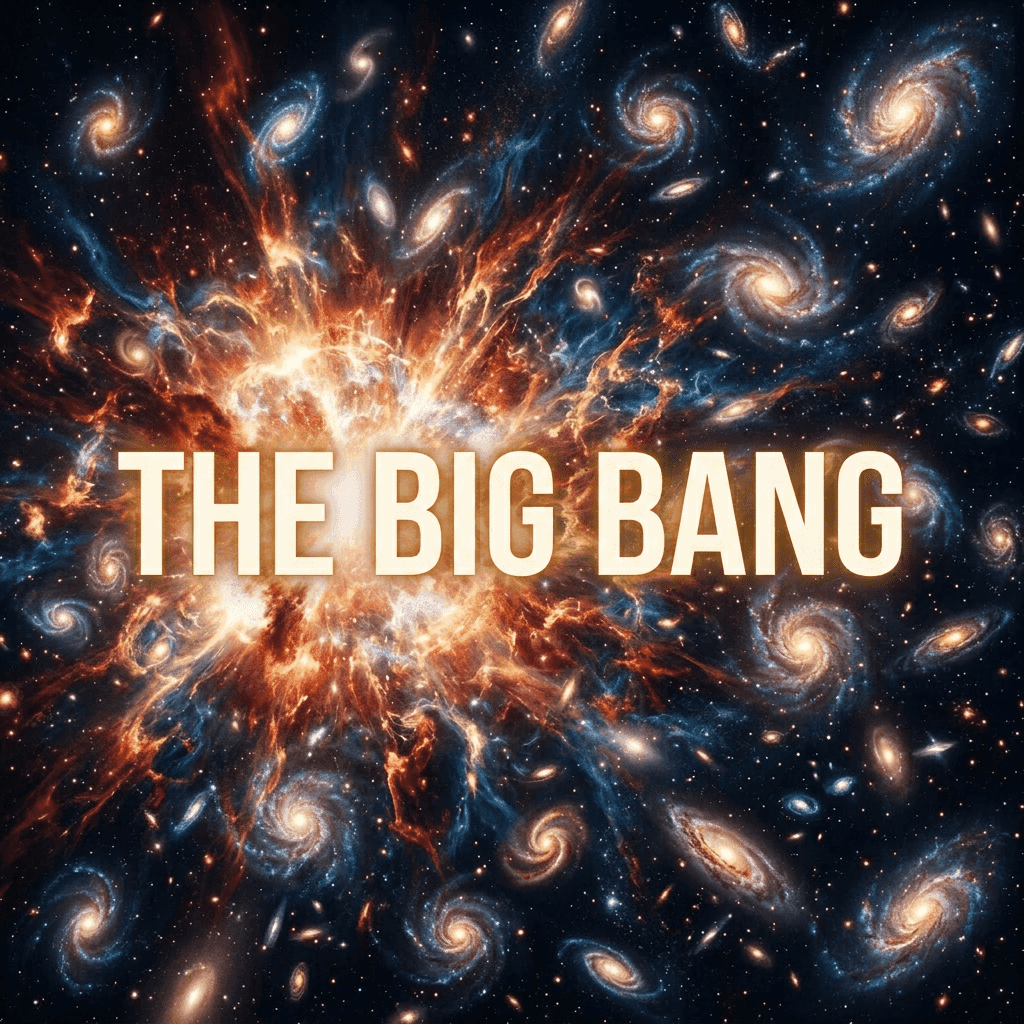
You can argue about life’s daily stress all you want, but when it comes to raw, mind-melting history, nothing beats the origin story of reality itself. We are talking about The Big Bang Theory, the prevailing cosmological model for the observable universe. Far from being a slow, quiet entry, the birth of our universe was a high-octane explosion of pure energy, intense radiation, and expanding space-time that defies human imagination.
Forget boring science lectures that treat cosmology like a dusty textbook page. The Big Bang Theory is a high-energy, fast-paced cosmic epic that proves everything we see—from massive galaxies to the molecules in your body—erupted from an inconceivably hot, infinitesimally small singularity roughly 13.8 billion years ago.
Here is your detailed, high-utility blueprint to the structural foundations of The Big Bang Theory, featuring a dramatic real-world story of a scientific prank that backfired so spectacularly it named the universe.
How Did a Skeptic’s Sarcastic Radio Insult Accidentally Name the Entire Universe?
To fully comprehend the fierce intellectual battles behind our cosmic history, we have to sneak inside a live BBC radio studio in March 1949. Imagine an arrogant, highly respected British astronomer named Fred Hoyle sitting behind a microphone. Hoyle was a fierce champion of the “Steady State” model, a theory claiming the universe has no beginning or end, remaining completely unchanging forever. He absolutely despised the emerging concept that the cosmos had a sudden, explosive birth.
Suddenly, during a live broadcast, Hoyle leaned into the microphone to mock his rivals’ math. Instead of using its formal academic title, he threw out a sarcastic, dismissive insult, calling the idea of a cosmic beginning a ridiculous, overblown “Big Bang”. He wanted the phrase to sound silly, unscientific, and completely dead on arrival.
The scientific community went into an absolute frenzy! Consequently, Hoyle’s sharp, catchy insult did the exact opposite of what he intended. The public loved the phrase, the media ran with it, and The Big Bang Theory officially stuck as the definitive name for our origins. This dramatic media backfire proved that you can’t stop a brilliant idea with pure sarcasm—the name became a multi-billion-dollar brand for science, cementing The Big Bang Theory into pop culture history forever.
What Absolute Pillars of Evidence Prove the Cosmic Expansion Is Real?
Moving forward from that radio drama, let’s look at the hard-hitting observational data that keeps The Big Bang Theory crowned as the undisputed king of cosmology. Because scientists demand absolute proof, the model relies on three rock-solid observational pillars that anyone can verify with advanced optical hardware.
- The Galactic Redshift Flex: In 1929, Edwin Hubble pointed his massive telescope at distant galaxies and noticed something wild. The light waves stretching from those galaxies were shifted toward the red end of the spectrum, proving they are flying away from us at extreme speeds.
- The Leftover Heat Blueprint: The universe didn’t just expand; it left behind a receipt. The Cosmic Microwave Background (CMB) is the literal glowing ember of the initial explosion, an invisible sea of microwave radiation that blankets the entire sky at a uniform temperature of 2.7 Kelvin.
- The Light Element Monopoly: The math behind The Big Bang Theory predicts that the early cosmic furnace could only forge the lightest elements. When astronomers survey deep outer space, they find that the universe matches the prediction perfectly, consisting of roughly 75% hydrogen and 25% helium.
How Did Penzias and Wilson Mistake the Whisper of Creation for Bird Droppings?
In addition to tracking galactic movements, uncovering the CMB radiation led to one of the most hilarious and high-utility accidents in the history of science. Furthermore, this close encounter shows that the secrets of deep outer space are often hiding in plain sight.
1. The Mysterious Antenna Hum
- The Incident: In 1964, Arno Penzias and Robert Wilson were testing a hyper-sensitive, horn-shaped radio antenna in New Jersey.
- The Chaos: No matter where they pointed the device, they kept picking up a persistent, irritating background hiss that ruined their data.
2. The Great Pigeon Purge
- The Incident: Convinced the noise was a local hardware issue, they climbed inside the giant horn.
- The Chaos: They found a pair of pigeons nesting inside, leaving a thick layer of white droppings. They spent days scrubbing the equipment clean and removing the birds, but the ghostly hum remained exactly the same.
3. The Nobel Prize Epiphany
- The Incident: They called up a team of theoretical physicists at Princeton University who were actively hunting for the lost heat of creation.
- The Chaos: The moment the theorists heard the hum’s exact frequency, they realized the engineers had accidentally tapped into the cosmic background radiation. That “pigeon static” was the literal echo of The Big Bang Theory ringing through space-time, a discovery that instantly won them a Nobel Prize.
What Unsolved Mysteries Threaten the Standard Model of Cosmology?
Ultimately, mixing quantum physics with general relativity means The Big Bang Theory still faces massive, high-stakes structural questions. Even with our advanced telescopes, the universe hides secrets that modern physics cannot explain yet.
- The Dark Matter Enigma: We can map the gravity of galaxies, but we quickly realize that visible matter only accounts for about 5% of the universe. The rest is held together by Dark Matter, an invisible, undetected mass that acts as a structural skeleton for the cosmos.
- The Dark Energy Acceleration: In 1998, scientists discovered that the expansion of outer space isn’t slowing down—it is actively speeding up. Something called Dark Energy is acting as a cosmic anti-gravity force, ripping the fabric of space-time apart at a accelerating rate.
- The Horizon Flatness Problem: When we look at opposite ends of the observable universe, the temperature is perfectly uniform. This requires a mind-bending process called Cosmic Inflation, an era in the first trillionth of a second where the universe ballooned faster than the speed of light to smooth out reality.
Final Thoughts: You Are the Cosmos Looking Back at Itself
In short, The Big Bang Theory isn’t just an abstract math problem for astronomers; it is the ultimate record of our shared heritage. Every atom in your left hand came from a different star than the atoms in your right hand, and all of it trace back to that single, chaotic moment of creation 13.8 billion years ago. So, the next time you look into the night sky, realize you are looking at the continuation of an epic cosmic journey. Keep your curiosity sharp, stay bold, and enjoy the show!
