
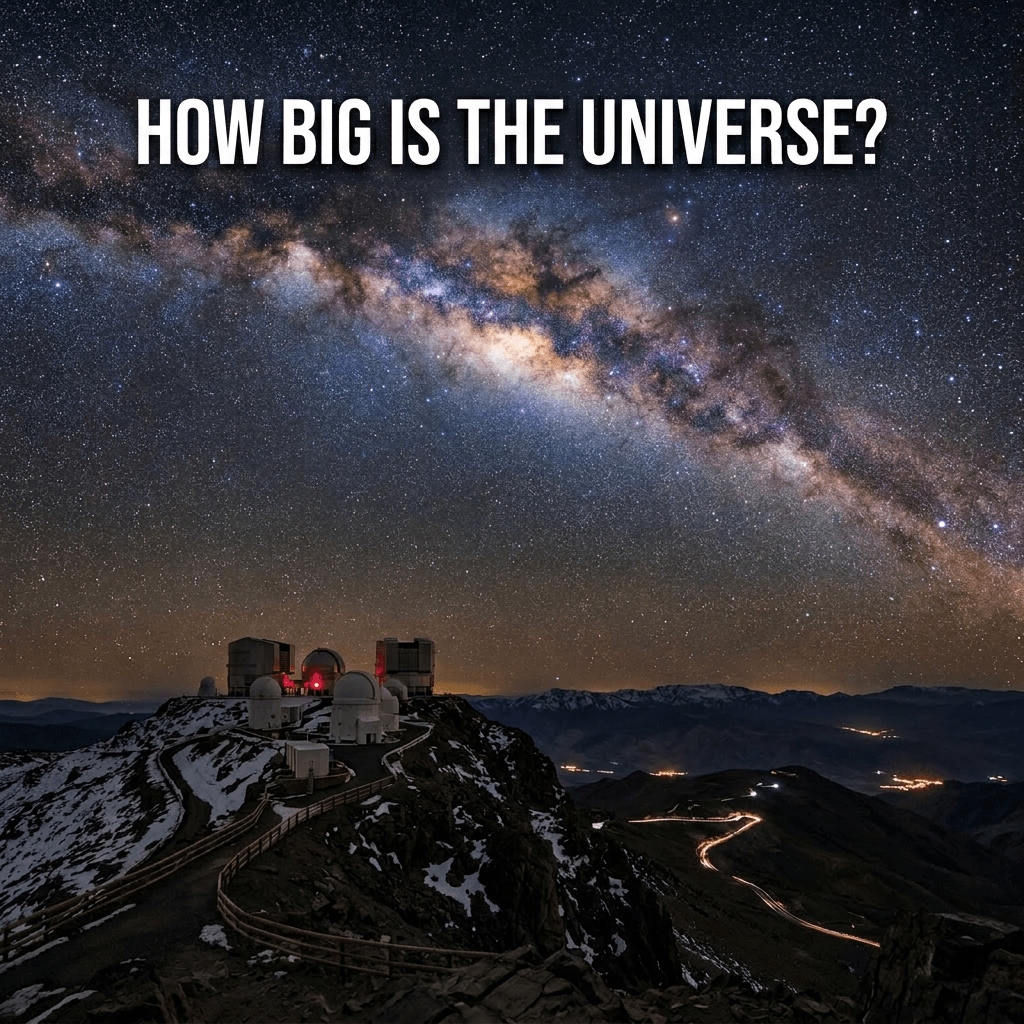
Imagine waking up to discover that your entire house is actually just a single microscopic speck of dust floating inside an endless, labyrinthine mansion.
That mind-melting realization is exactly what happens when you look up at night and ask: How Big Is the Universe? The Ultimate Cosmic Mystery Unveiled. Strap in, space travelers, because the sheer scale of outer and deep space is about to blow your mind. We are going to explore the jaw-dropping truth behind the size of our reality. The journey requires a blend of hardcore science and dramatic storytelling.
Why Does One Stargazer’s Heart Beat Faster?
Lyra stared through her telescope, her breath fogging the chilly glass. For months, she had been searching the constellation of Orion for a specific rhythmic pulse of light. Suddenly, a signal flared—a brilliant, rhythmic flash from a distant star system. Beside her, Leo, her brilliant astrophysicist partner, gasped as the telemetry data flooded their monitors.
“Lyra, look at the redshift values,” Leo whispered, his hand trembling as it brushed against hers. “That light left its source billions of years ago.”
Their eyes locked in a moment of pure, terrifying romantic tension. The distance between them vanished, even as they stared directly into the terrifyingly vast abyss of deep space. They realized that the light they were holding in their hands was an ancient echo from a time before Earth even existed.
What Is the Actual Size of the Observable Universe?
To understand what Lyra and Leo were looking at, we must look at concrete numbers. The patch of space we can actually see is called the observable universe. According to official measurements from the NASA Universe Exploration database, the observable universe stretches roughly 93 billion light-years in diameter.
A single light-year is the distance light travels in one year. Light travels at an incredible speed of about 186,000 miles per second. Multiplying that out means the observable bubble spans over 540 sextillion miles.
This boundary exists because the universe is roughly 13.8 billion years old. Light from objects farther away simply has not had enough time to reach our telescopes yet.
How Can Space Expand Faster Than the Speed of Light?
If the universe is 13.8 billion years old, how can the diameter be 93 billion light-years? This sounds like a glaring math error, but it is actually the beauty of cosmic inflation.
Space itself is expanding. It does not just expand anywhere; it expands everywhere at once.
Data published by the ESA Planck Mission confirms that cosmic expansion stretches the fabric of space-time itself. While matter cannot travel through space faster than light, space itself can expand at any speed it wants. The distant galaxies that emitted light billions of years ago have raced away from us while that light was mid-flight. This expansion creates a much larger bubble than age alone suggests.
What Lies Beyond the Edge of Our Vision?
This is where things get truly wild. The observable universe is just our local neighborhood. What lies beyond the 93-billion-light-year horizon?
Astronomers use deep-space measurements to calculate the curvature of space-time. The latest cosmological data indicates that the universe is remarkably flat.
A perfectly flat universe has staggering implications for total volume. According to research compiled by the Caltech IPAC Center, a flat geometry implies that the entire universe is likely infinite in extent. If you traveled in a straight line forever, you would never run out of space, encountering infinite variations of stars and galaxies along the way.
Did Lyra and Leo Unlock the Infinite Mystery?
Back in the observatory, the telemetry data confirmed the cosmic scale. Lyra smiled, leaning closer to Leo as the monitors illuminated the room in shades of nebula blue.
“It goes on forever, doesn’t it?” she asked softly.
Leo smiled back, holding her hand tightly. “The universe might be infinite, Lyra, but finding you in a space this big makes me think the odds don’t matter at all.”
Their discovery proved that while our cosmic home is unimaginably vast, our capacity to wonder, love, and explore is just as limitless.
