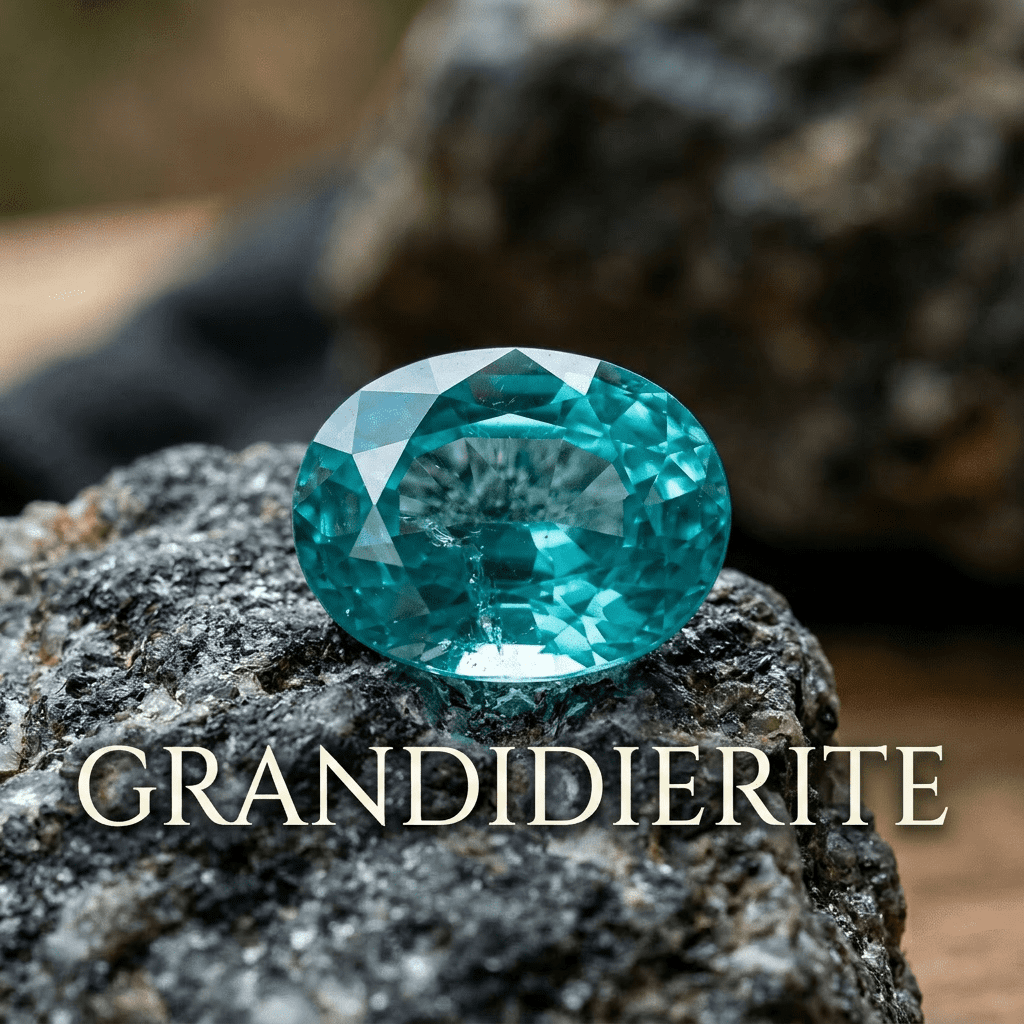
Imagine digging through thousands of tons of rough stone under a scorching sun, only to find a tiny, mesmerizing flash of neon ocean water hidden inside the dark earth. This is the elusive reality of hunting for Grandidierite, one of the most incredibly scarce treasures on the planet. It is so highly prized that gem experts and elite collectors consider it a crown jewel of any mineral collection. If you want to master your knowledge of elite gemstones, you must understand Grandidierite, an extremely rare, bluish-green silicate mineral.
Want to Hear a Thrilling Tale of Deception and Discovery?
The air inside the dimly lit auction room was thick with tension as the final lot of the night approached. Master gem cutter Julian adjusted his collar, his fingers trembling slightly as he clutched a small velvet pouch containing a flawless, faceted 2-carat specimen of Grandidierite—a stone he had spent six agonizing months cutting under a microscope. Suddenly, the heavy doors burst open, and a notorious rival collector, Elena, stepped into the room with a malicious smile. She falsely claimed aloud that Julian’s masterpiece was nothing more than a common blue apatite.
Gasps echoed through the crowd, and the auctioneer raised his gavel, threatening to disqualify the lot. Julian held his breath, knowing that a single fracture during the cutting process could have destroyed the stone entirely. Stepping up to the podium, Julian shone a powerful penlight through the gem at different angles. The crowd watched in absolute awe as the stone shifted instantly from deep ocean blue-green to a sharp, icy yellow, proving its intense pleochroism. Elena slipped away into the shadows, defeated, as the gavel fell at a jaw-dropping record price.
What exactly is Grandidierite?
This breathtaking material is a complex borosilicate mineral that owes its signature, electrifying appearance to trace amounts of iron within its crystal structure. On the official Mindat Mineral Database, it is categorized within the orthorhombic crystal system, meaning it typically forms elongated, prismatic crystals in very specific geological environments.
What makes Grandidierite truly magical to look at is its extreme trichroic pleochroism. When you rotate a high-quality crystal, it flashes three entirely distinct colors depending on your viewing angle: dark blue-green, light yellow, and deep teal.
Why is this mineral so incredibly rare?
While low-grade, opaque mineral specimens have been found in small quantities around the globe, true gem-quality crystal material is found almost exclusively in the remote regions of southern Madagascar. According to documentation from the Gemological Institute of America (GIA), a major deposit breakthrough occurred near Tranomaro in 2014, yet the yield remains shockingly low.
Out of a massive 800-kilogram harvest of rough mineral material extracted from these deposits, only a measly 50 to 60 grams were clear, transparent crystals. Furthermore, because the mineral exhibits distinct cleavage in two directions, it is notoriously fragile to cut. Gem cutters regularly lose over half of the rough stone’s weight trying to shape a single faceted gem, making any clean stone over one carat an absolute miracle.
How much is Grandidierite actually worth?
Because of its undeniable beauty, exceptional durability, and extreme scarcity, it has been highlighted by financial authorities like Forbes Magazine as the third most expensive gemstone in the world. It boasts a formidable score of 7 to 7.5 on the Mohs hardness scale, making it durable enough for elite jewelry design.
If you are looking to purchase investment-grade material, clean and transparent faceted stones easily command wholesale prices ranging from $20,000 to $26,000 per carat. For collectors on a budget, translucent specimens or cabochon cuts with visible inclusions can be found for lower prices, but the top-tier, crystal-clear variants remain safely locked in the vaults of billionaires.
How can you identify a real specimen?
- Look for Trichroism: A real gem must change colors when viewed from different angles.
- Check the Hardness: It will easily scratch glass and resists everyday wear flawlessly.
- Analyze the Saturation: True gem-grade material features an unmistakable, neon blue-green pop.
- Demand Certification: Always insist on a verified lab report from an established gemological institution.
Exploring the world of exotic geology reveals just how magnificent earth’s chemistry can be when the perfect conditions align. Grandidierite stands as a magnificent testament to that natural mystery, capturing the untamed beauty of the ocean inside a rock harder than steel.
