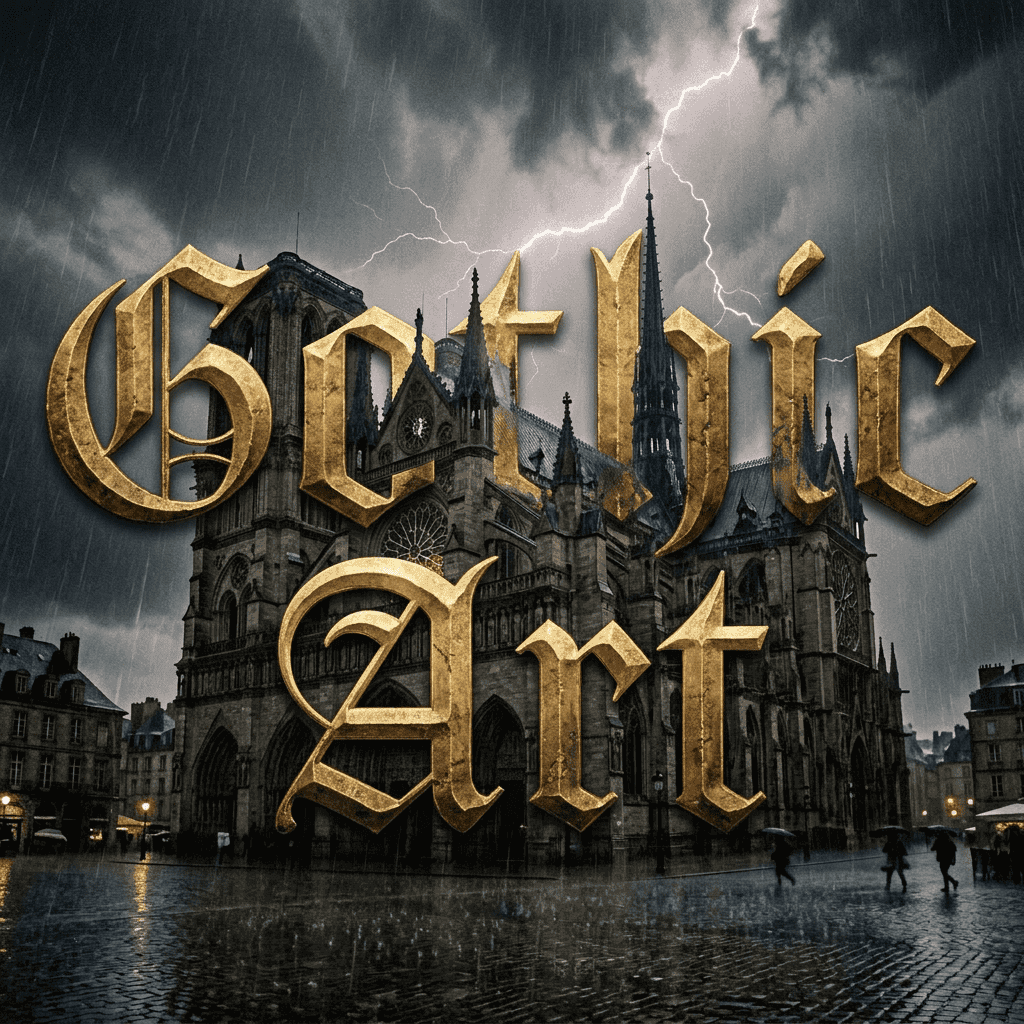
Step away from the dark, windowless fortresses of the early Middle Ages and look upward into a breathtaking world where massive stone walls seem to dissolve into pure, glowing fields of multicolored glass. This spectacular visual explosion is not a modern design trend; it is the revolutionary reality of Gothic Art, a historic movement that completely transformed European culture from the twelfth to the sixteenth century. By trading heavy, rounded Romanesque arches for soaring vertical heights and fluid human emotions, medieval builders created an architectural and artistic framework that still defines the skylines of the world’s greatest cities. If you want to understand how human engineering first learned to transform heavy mountain stone into weightless heavenly light, you must master the secrets of Gothic Art.
Ready for a Suspenseful Tale of Forbidden Blueprints and Catacomb Sabotage?
The icy rain beat a relentless rhythm against the wooden scaffolding of the unfinished cathedral in Paris as Master Mason Thomas clutched a leather tube tightly to his chest. For three agonizing years, he had been secretively drafting a radical new blueprint to save the nave from collapsing under its own immense weight—a daring design featuring elegant external arches known as flying buttresses. But his bitter rival, a traditionalist named Robert, fiercely opposed this modern engineering. Robert falsely claimed to the bishop that Thomas’s progressive calculations were mathematically unstable and bordered on dangerous sorcery.
Suddenly, a heavy shadow detached itself from a dark stone pillar right in front of Thomas, blocking his path along the narrow, rain-slicked ledge. It was Robert, his face twisted in malice, holding a burning torch over an open shaft leading down into the freezing catacombs. “Hand over the drawings, Thomas,” Robert sneered, stepping closer, “or your precious calculations will burn before the bishop ever lays eyes on them.” Thomas held his breath, his heart hammering violently against his ribs as he glanced down at the dizzying hundred-foot drop below.
Thinking fast, Thomas feigned a stumble on the wet stone, intentionally dropping his heavy iron drafting compass. The metal tool clattered loudly against the stone floor, echoing through the empty nave like a snapping bone. Startled by the sudden noise, Robert lurched backward, losing his footing on the slick moss. As Robert slipped, the burning torch flew from his hand, plunging harmlessly into the dark abyss below. Thomas lunged forward with lightning speed, catching his rival by the collar of his heavy wool cloak just before he tumbled over the edge. Trembling and defeated in the dark, Robert finally surrendered, allowing Thomas’s revolutionary blueprints to pass safely to the builders and permanently change the history of architecture forever.
What exactly is Gothic Art?
This monumental international style made its official debut around 1144 in France with the completion of the stunning Abbey Church of Saint-Denis, envisioned by the brilliant Abbot Suger. Abbot Suger famously pioneered the philosophical concept that physical light is a direct, visible manifestation of the divine, meaning that holy spaces needed to be flooded with color to elevate the human soul.
As beautifully detailed in historical overviews curated by the Victoria and Albert Museum, the movement quickly expanded beyond stone architecture. It fundamentally redefined panel painting, monumental sculpture, illuminated manuscripts, and luxury metalwork. Across all these diverse mediums, creators deliberately walked away from the stiff, flat, and stylized forms of the past, opting instead to introduce a highly advanced sense of naturalism and deep psychological expression.
How did structural innovations completely alter medieval buildings?
- Pointed Arches: Unlike traditional rounded arches, these structures direct the immense weight of the roof more efficiently downward.
- Ribbed Vaults: Intersecting stone arches allowed masons to construct significantly taller, lighter, and more versatile ceilings.
- Flying Buttresses: These external bracing arches absorb the lateral outward thrust of the massive roof, freeing the interior walls from carrying heavy loads.
- Stained Glass Clusters: With the walls structurally relieved of carrying weight, builders filled massive openings with vibrant narrative glass panels.
Why did sculpture and painting undergo an emotional revolution?
If you observe the transition of figures over this four-century span, the stylistic evolution is remarkably fun to trace. In earlier eras, figures in sculpture and painting appeared rigid, solemn, and completely detached from human experience. However, artisans during this progressive era realized that viewers were far more likely to engage with historical narratives if the characters expressed authentic human feelings.
According to comprehensive style analyses hosted on the Mindat Mineral and Cultural Database, statues began to physically detach themselves from the heavy architectural columns behind them, stepping forward into free space. Sculptors introduced the elegant “Rückenfigur” and the famous “S-Curve” pose, which allowed carved garments to drape naturally over shifting hips. Faces were injected with unmistakable human psychology—showing subtle grins, profound grief, maternal tenderness, and deep contemplation.
Where can you see these magnificent masterpieces in person today?
To experience the true, jaw-dropping scale of this movement, you only need to explore the historic cities of Western Europe. The definitive, golden baseline is the cathedral of Notre-Dame de Paris, which began construction in 1163 and famously influenced generations of builders with its iconic rose windows and protective gargoyles.
You can also explore these historical milestones closer to home. The Metropolitan Museum of Art hosts a rare, world-class exhibition titled Gothic by Design: The Dawn of Architectural Draftsmanship. This display introduces audiences to the intricate, highly technical preparatory drawings and master-mason prints that allowed these monumental medieval structures to be built with mathematical precision across Europe.
