
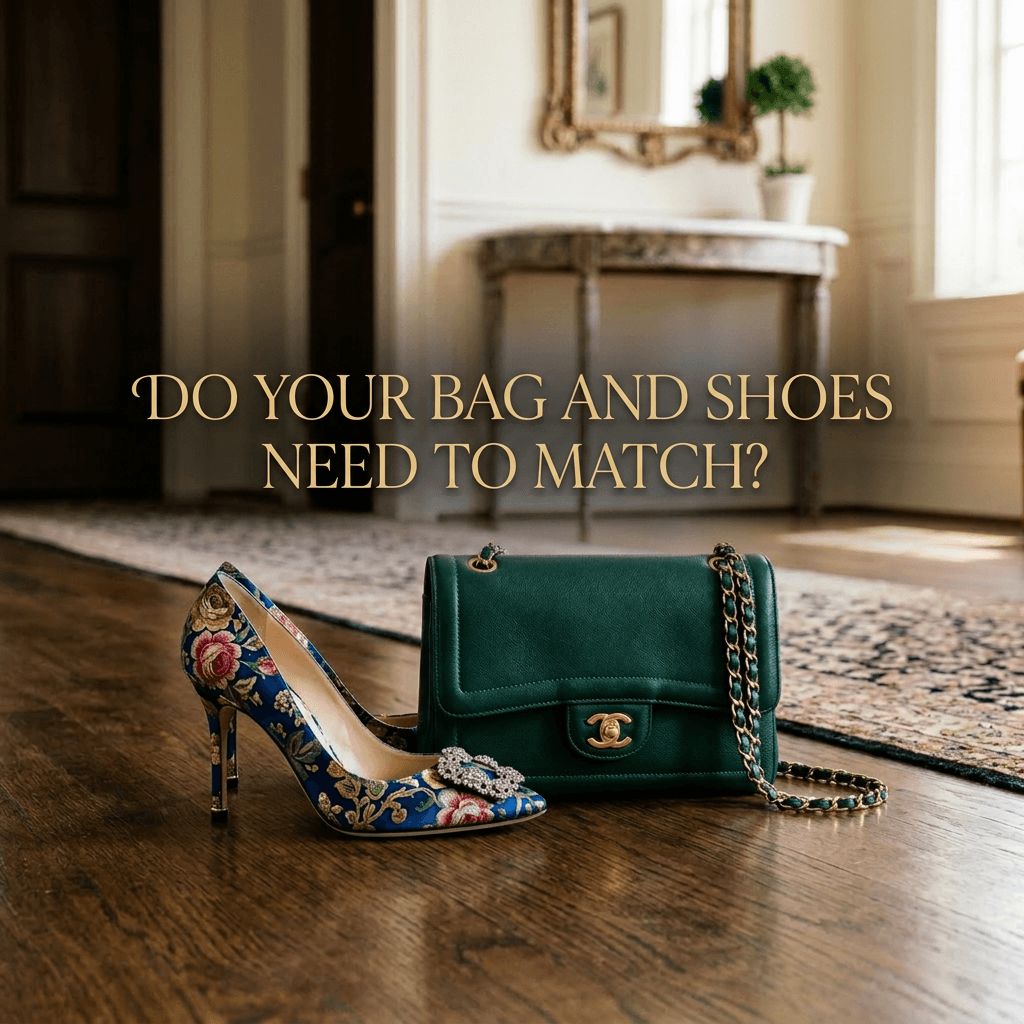
The flashing red lights of the Paris police cruiser cut through the midnight fog, but Julianne’s heart was racing for a completely different reason: she had just committed the ultimate high-fashion crime, and her freedom depended entirely on whether her vintage, quilted Chanel classic flap bag could survive being paired with neon-orange Balenciaga sneakers.
She had sprinted out of the gala after discovering the gemstone inside her companion’s signet ring was a counterfeit, leaving behind her towering stiletto heels to escape across the cobblestones. Safe inside the getaway car, she stared at her mismatched reflection. In that breathtaking moment of high-stakes survival, the age-old style commandment flashed through her mind: do your bag and shoes need to match? Let’s dive into the rules of modern luxury to see if breaking this tradition is a felony or pure fashion genius.
Is The Exact-Match Rule Officially Dead?
Absolutely. Historically, matching your leather goods was the gold standard of high society, but today’s elite luxury landscape champions individuality over rigid conformity. The strict rule stating your accessories must come from the exact same dye lot is a relic of the past.
According to contemporary style authority reports on Vogue Magazine, modern fashion is entirely about effortless elegance—often referred to as “sprezzatura.” Forcing a precise match between your footwear and your luxury handbag can actually age an outfit, making it look overly calculated rather than stylishly organic.
How Do You Mix Colors Without Looking Chaotic?
If you aren’t matching your items, you must balance them using intentional color theory. Instead of pairing identical shades, try using complementary colors or varying tones within the same color family.
- The Neutral Anchor: Pair a vibrant handbag, like an Hermès Birkin in classic Orange Poppy, with neutral shoes in beige, cream, or black.
- Tonal Harmony: Combine different textures and shades of the same base color, such as an olive green suede bootie with an emerald green alligator clutch.
- The Metallic Bridge: Use gold or silver hardware on your luxury purse to dictate the tone of your jewelry and footwear accents.
Can You Successfully Pair Different Brands?
Yes, you can absolutely mix design houses, provided the structural aesthetics and craftsmanship align. A structured, minimalist bag pairs beautifully with clean, architectural footwear, regardless of the logos stamped on the insoles.
Major luxury curators at platforms like The RealReal frequently demonstrate that mixing a vintage Gucci monogrammed shoulder bag with sleek, unbranded Italian leather loafers creates a highly sophisticated, curated aesthetic. The secret is ensuring that one piece acts as the statement star while the other serves as the supporting actor.
When Is Matching Still Necessary?
While daily street style rewards experimentation, ultra-formal environments still call for traditional coordination. Black-tie galas, royal protocol events, and conservative corporate environments are places where mismatched accessories can distract from a polished presentation.
For these high-stakes moments, luxury institutions like Chanel still design coordinated sets. However, even in formal settings, you can modernize the look by matching the undertone or the material texture rather than insisting on an identical color profile.
Julianne eluded the Parisian authorities that night because her mismatched silhouette blended into the eclectic crowds of the underground metro—proving that sometimes, breaking the fashion rules is the only way to survive.
