
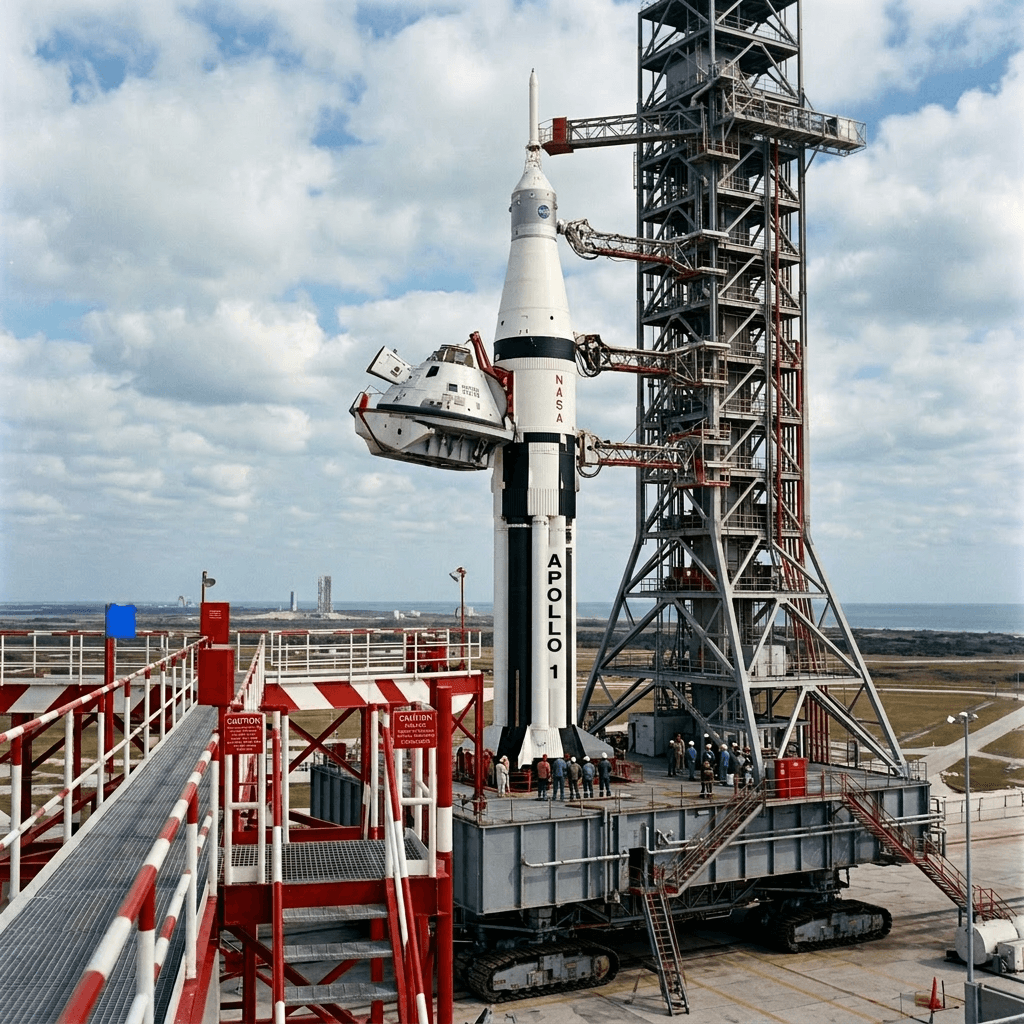
Outer space exploration is a thrilling journey of survival, courage, and ultimate sacrifice that tests the very limits of human capability. Fire erupted inside the spacecraft cabin during a routine launch rehearsal on January 27, 1967. Within seconds, a toxic nightmare trapped three of America’s bravest pioneers. Astronauts Gus Grissom, Ed White, and Roger Chaffee were scheduled to fly the historic first manned mission of the Apollo program. Instead, their sudden loss stunned a nation and ground the race to the moon to a complete halt. Yet, out of the devastating ashes of this outer space exploration disaster, NASA completely rebuilt its safety protocols to successfully conquer the heavens.
What Real Horror Unfolded Inside Command Module 012?
The air inside the cockpit felt heavy, pure, and intensely volatile. On that cold January afternoon at Cape Kennedy, the crew strapped into their seats for a crucial “plugs-out” simulated countdown. NASA engineers flooded the cabin with pure oxygen at a high pressure of 16.7 pounds per square inch to mimic space conditions.
Suddenly, a tiny, stray spark from a bruised wire beneath Grissom’s couch found a pocket of flammable material. It ignited instantly. Because pure oxygen accelerates combustion to a demonic speed, a localized spark turned into an inferno in fractions of a second.
“Fire!” a frantic voice called out over the radio, identified by analysts as Chaffee. “We’ve got a fire in the cockpit!”
White instantly reached overhead to actuate the complex hatch release mechanism. But the design of the inner hatch required it to be pulled inward into the cabin. The intense heat had rapidly expanded the gases inside, sealing the inner hatch shut with thousands of pounds of pressure. It was physically impossible to open.
Outside, technicians rushed toward the white room through a wall of dense, toxic smoke. They fought desperately to clear the hatch, but the pure oxygen environment caused the spacecraft hull to rupture from internal pressure. Within just 17 agonizing seconds after the first distress call, the cabin went completely silent. The three astronauts passed away from carbon monoxide asphyxiation.
Why Did NASA Use a Deadly Pure Oxygen Atmosphere?
The decision to use 100% pure oxygen came down to engineering simplicity and weight management. A mixed-gas system utilizing nitrogen and oxygen requires heavy high-pressure tanks, complex mixing valves, and sophisticated sensor arrays.
NASA engineers chose pure oxygen because it allowed the spacecraft hull to be built much lighter. They reasoned that since they had used pure oxygen in both the Mercury and Gemini programs without any fatal inflight issues, it was fundamentally safe.
However, they ignored the extreme danger of testing high-pressure pure oxygen on the launchpad. At sea level, a cabin requires far higher pressure to prevent structural collapse than it does in the vacuum of deep space. This high pressure turned every single velcro strip, nylon net, and foam pad inside the command module into a high-grade explosive waiting for a single match.
How Did the Tragedy Transform Future Spaceship Designs?
The disaster forced NASA to implement a complete, top-to-bottom redesign of the Apollo Command Module. They immediately abandoned pure oxygen for ground operations, switching to a safer 60% nitrogen and 40% oxygen mix during launch sequences.
Engineers replaced all flammable materials inside the cabin with self-extinguishing Beta cloth, which is woven from non-combustible fiberglass. Every single mile of electrical wiring was heavily insulated and shielded against potential short circuits.
Most importantly, NASA developed a brand-new, outward-opening quick-release hatch mechanism. This revolutionary design allowed the crew or ground technicians to open the module safely in under five seconds under any pressure condition. According to official historical records from the NASA Apollo 1 Mission Overview, these precise safety improvements directly saved the lives of later lunar crews. Without the lessons bought by the loss of Apollo 1, the later NASA Apollo 11 Lunar Landing might have ended in an identical catastrophe.
Can We Truly Honor the Sacrifices of These Brave Pioneers?
The legacy of the lost crew extends far beyond the launchpad where they took their final breaths. Their ultimate sacrifice forced a culture of absolute engineering transparency and rigorous accountability across the global aerospace industry.
Flight Director Gene Kranz famously instituted the “Kranz Dictum” to his entire staff immediately following the accident investigation. He declared that from that day forward, the space flight operations team would be forever “tough and competent.” They would never again take safety for granted or allow schedules to compromise human lives.
Today, the lessons learned from Apollo 1 remain foundational to modern deep space journeys, including the current NASA Artemis Program. The brave souls of Apollo 1 gave their lives on Earth so that future generations could safely walk among the distant stars.
