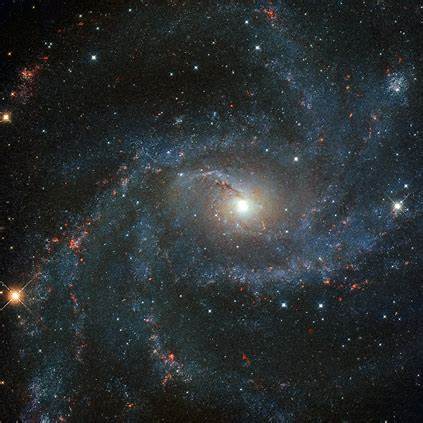
Tucked between the constellations Cepheus and Cygnus is a spiral galaxy that has more
drama than a celestial soap opera. Astronomers call it NGC 6946, but stargazers with flair
call it the Fireworks Galaxy—because it keeps exploding in supernovae like it’s celebrating
New Year’s Eve every other decade.
But in ancient cosmic tales, this galaxy wasn’t just loud—it was sacred.
The Legend of Cindra, Goddess of Reignition
Before time had rules, there was a goddess named Cindra, known as the Reigniter of Flame.
She was the spark at the end of everything—called not to birth stars, but to light their final
breath. She didn’t mourn the end of stars. Instead, she danced in their explosions, reigniting
cosmic ash into something brighter.
The gods thought this was madness—until they saw what came after:
Stars reborn as nebulae. Planets forged in the chaos. Life made possible by destruction.
In honor of her devotion to cycles, the gods gave her a home:
A galaxy that would forever burst with dying stars, so her flame would never go out.
That galaxy was the Fireworks Galaxy—a celebration of endings, and the beauty that follows.
What’s Really Going On?
Name: NGC 6946
Nickname: The Fireworks Galaxy
Location: Border of constellations Cepheus and Cygnus
Distance: ~22 million light-years from Earth
Type: Face-on spiral galaxy
Supernova City: It has had 10+ observed supernovae in the past 100 years, which is unusually
high for one galaxy
Starburst activity: It’s forming new stars at a rapid rate, especially in its outer arms
Basically, it’s the universe’s own firework factory—booming with energy, rebirth, and a
whole lot of cosmic flair.
Final Thoughts
The Fireworks Galaxy reminds us that destruction isn’t always the end. Sometimes, it’s just
the start of a new kind of beauty. In the universe, even death throws a party—and Cindra
makes sure the sky stays lit.
So the next time things feel like they’re burning down, remember:
Maybe it’s just your stars getting ready to shine brighter.